

State Laws
Section 417(a) of the Limited Liability Company Law is a command: subject to the chapter, “the members of a limited liability company shall adopt a written operating agreement” about the business, the conduct of its affairs and the rights, powers and duties of members, managers, employees and agents, so long as its terms are consistent with the law and with the articles of organization. Subdivision (c) sets the timing. The agreement may be entered into before, at the time of, or within ninety (90) days after the articles are filed, and “under no circumstances shall an operating agreement become effective prior to the formation” of the company.
None of the sections cited below is a single list of what the agreement cannot do; the limits sit inside the sections themselves: § 417(a)(1) and (2) let the agreement limit or eliminate a manager’s liability to the company except where a judgment or other final adjudication establishes bad faith, intentional misconduct, a knowing violation of law, a financial profit or other advantage the manager was not legally entitled to or, for a distribution covered by § 508(a), acts not performed under § 409, and never for acts before the provision was adopted; § 417(b) wants the written consent of each member adversely affected by an amendment that increases contributions, alters the allocation of tax items, alters how distributions are computed or lets a contribution obligation be compromised by fewer than all the members, unless the agreement or articles provide otherwise; § 402(e) forbids amending a provision that requires a specific percentage vote with less than that percentage; and § 420 bars indemnifying a person whose bad faith or active and deliberate dishonesty, material to the cause of action, or improper personal gain is established by a judgment or other final adjudication.
| Rule | New York default | Section |
|---|---|---|
| Who manages | The members, unless the articles of organization provide for one or more managers | § 401(a) |
| Weight of a vote | In proportion to the member’s share of the current profits | § 402(a) |
| Ordinary decisions | A majority in interest of the votes cast at a meeting; debt outside the ordinary course takes a majority in interest of the voting members | § 402(f), § 402(c)(2) |
| Admitting a member | The vote or written consent of a majority in interest; an assignee becomes a member on the same vote, the assignor not counted | § 602(b)(1), § 604(a) |
| Amending the agreement | A majority in interest of the voting members | § 402(c)(3) |
| Profits, losses and distributions | By the value of each member’s contributions as stated in the company’s records, leaving out promised contributions not made and contributions returned | § 503, § 504 |
| Transfer of an interest | Assignable in whole or in part; the assignee takes only the distributions and allocations the assignor would have received, with no vote and no management rights | § 603(a)(1) to (3) |
| Withdrawal | Only at the time or on the events the agreement states; absent such a term, no withdrawal before dissolution and winding up | § 606(a) |
| A member’s death | The company continues unless a majority in interest of the remaining members votes within one hundred eighty (180) days to dissolve; the estate’s representative may exercise the member’s rights to settle the estate | § 701(b), § 608 |
| Vote to dissolve | At least a majority in interest of the members, by vote or written consent | § 701(a)(3) |
| Order of payment on winding up | Creditors, including members who are creditors; then distributions already owed to members and former members under §§ 507 and 509; then the return of contributions; then the members in the proportions of § 504 | § 704(a) to (c) |
| Ceiling on distributions | None to the extent that, after it, the company’s liabilities (other than those to members on their interests and those limited to specified property) exceed the fair market value of its assets | § 508(a) |
Forming the company
Articles of organization go to the Department of State; the notice goes to two newspapers; the agreement stays with the company.
Under § 203(e) the articles state, among other items, the company’s name, the New York county of its office, any latest dissolution date, the designation of the Secretary of State as agent for service of process with a mailing address for process, and, if there is one, the registered agent; § 203(d) forms the company when the articles are filed, or at a later date in them no more than sixty (60) days out. The fee is in § 1101(f): $200 for filing the articles.
|
The operating agreement is not filed. Section 1102(a)(4) places “a copy of the operating agreement, any amendments thereto and any amended and restated operating agreement” among the records the company keeps, which may be kept in or outside the state, with the members’ list, their contributions and shares of profits and losses, the articles, and the income tax returns of the three (3) most recent fiscal years; § 1102(b) lets a member inspect and copy them for a purpose reasonably related to the member’s interest.
Signing
All of the members sign; the manager signs too when the articles provide for managers.
Section 417(a) puts adoption on “the members”, so the document has each of them sign; the section does not say how they adopt it. Section 417(b) asks for an adversely affected member’s written consent only to the amendments it lists. The section, read in full on 2026-11-01, contains none of the words notary, acknowledged or witness, so § 417 requires no acknowledgment. Members who sign electronically rely on 15 U.S.C. 7001(a)(2): no contract in or affecting interstate commerce loses legal effect solely because an electronic signature or electronic record formed it.
Federal tax
A New York company with two (2) or more members is classified as a partnership under Treasury Regulation § 301.7701-3(b)(1)(i), read on govinfo.gov, unless it elects otherwise on Form 8832 or chooses S corporation status on Form 2553. The partnership files Form 1065 and obtains its employer identification number with Form SS-4.
Without an agreement
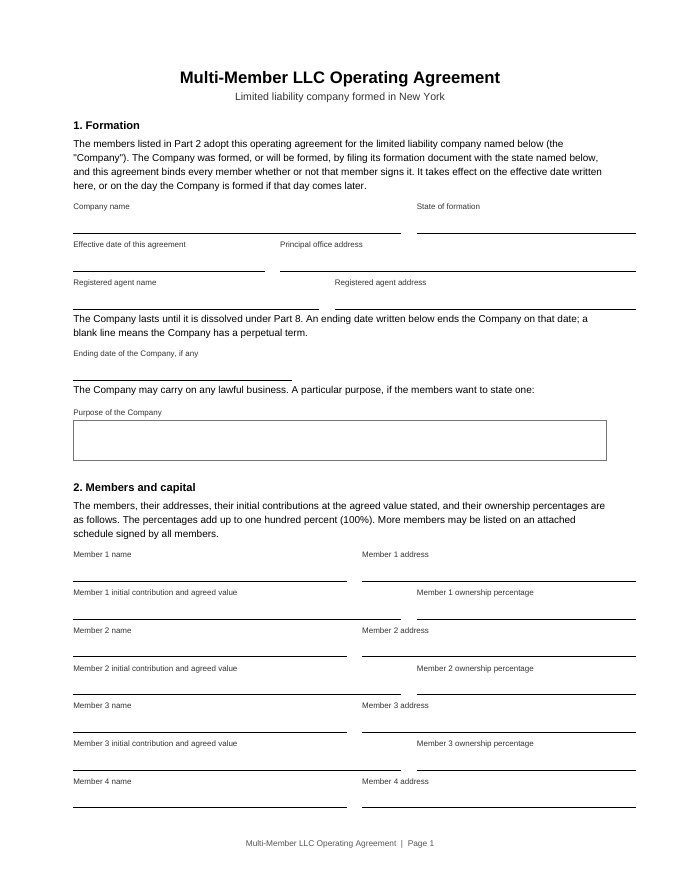
Sections 402(c), 603(a), 604(a) and 704(b) and (c) each open with “except as provided in the operating agreement”, so a company that never adopted one runs on those defaults. Two of them are easy to overlook: under § 402(c) a majority in interest, not everyone, can admit a new member or rewrite the agreement, and under § 606(a) a member has no right to withdraw before the company dissolves unless the agreement provides otherwise. The rest of the family of documents is under LLC operating agreement; the four-member text this New York document is built from is the multi-member LLC operating agreement.
Frequently asked questions
What happens if a New York LLC has no written operating agreement?
Section 417(c) says an operating agreement “may be entered into” before, at the time of or within ninety (90) days after the filing of the articles; it states no later cutoff, and no penalty, fine or loss of status is written into § 417 or § 203. The defaults in the table apply until an agreement is adopted, § 417(a) still says the members shall adopt one, and § 417(c) bars only an effective date earlier than formation.
Does a member who assigns an interest leave the company?
Unless the operating agreement provides otherwise, § 603(a)(4) ends the membership of a member who assigns the entire interest, and under § 603(a)(2) the assignee does not become one. The assignee holds the distributions and allocations alone until a majority in interest of the other members admits the assignee under § 604(a), and § 605 says an assignment does not release the assignor from liability, apart from certain liabilities that arise after it.
What does a withdrawing member get?
When the agreement allows the withdrawal, § 509 pays the member the distributions the agreement provides or, if it is silent, the fair value of the interest as of the withdrawal date, within a reasonable time. A member who knowingly takes a distribution that breaks § 508(a) is liable to the company for its amount (§ 508(b)), and § 508(c) ends that liability three (3) years after the distribution unless otherwise agreed.