

State Laws
Ohio’s act is the Ohio Revised Limited Liability Company Act, chapter 1706 of the Revised Code (R.C. 1706.02). The chapter, read on 2026-11-01, never tells the members to adopt an operating agreement. R.C. 1706.01(R) defines one as “any valid agreement, written or oral, of the members, or any written declaration of the sole member”, and R.C. 1706.16(D) lets the members make it before, at the time of or after the articles are filed and date its effect back to the filing. R.C. 1706.081 binds the company whether or not it assented, makes an admitted member a party, and says a one-member agreement is not unenforceable for having one party.
The chapter rewards writing. Under R.C. 1706.08(B)(1) fiduciary duties “may be expanded or restricted or eliminated by a written operating agreement”, and under (B)(2) a written agreement may limit or eliminate liability for breach. (B)(4) and (B)(5) let the agreement set penalties for a member who fails to perform, down to forfeiting the interest or forcing its sale. Against that, R.C. 1706.08(C) lists eight (8) things no agreement may do: vary the company’s status as a separate legal entity; restrict the rights under the chapter of anyone other than a member, dissociated member or assignee (R.C. 1706.082(B) excepted); vary a court’s power under R.C. 1706.171; eliminate the implied covenant of good faith and fair dealing; limit liability for a bad-faith violation of it; waive the signed-writing rule for contribution promises in R.C. 1706.281(A); waive the ban on bearer certificates; or waive the series statement rule.
The defaults the document replaces
| Rule | Ohio default | Section |
|---|---|---|
| Management | The company’s activities are under the direction and oversight of its members; a manager is any person the company or its members designate with authority to manage all or part of its affairs | R.C. 1706.30(A)(1), 1706.01(O) |
| Weight of a vote | Decisions count members, not percentages: “a majority of the members” | R.C. 1706.30(B)(1) |
| Ordinary decisions | A majority of the members; a decision to make a distribution is an ordinary decision | R.C. 1706.30(B)(1), 1706.29(A)(2) |
| Acts outside the ordinary course, or a bankruptcy petition | The consent of all members | R.C. 1706.30(C)(1)(b), (c) |
| Admitting a member | As the agreement provides, by the consent of all members, as the result of a merger or conversion under R.C. 1706.71 to 1706.74, or by a designated person within ninety (90) days after the last member dissociates | R.C. 1706.27(B)(1) to (4) |
| Amending the agreement | The consent of all members, or any other manner the agreement allows | R.C. 1706.082(A), 1706.30(C)(1)(a) |
| Sharing of distributions | All members share equally; a distribution in kind follows each member’s share of contributions | R.C. 1706.29(A)(1), (3) |
| Transfer of an interest | An assignment is permitted; the assignee has the right to receive, in accordance with the assignment, the distributions the assignor would otherwise be entitled to, and, subject to R.C. 1706.332, the assignment does not entitle the assignee to participate in management or to have access to records; except as R.C. 1706.411(J) provides, the assignor keeps the rights of a member other than the right to the distributions assigned | R.C. 1706.341(A), (B), (F) |
| Withdrawal | “A person shall not voluntarily dissociate”; a dissociation that breaks an express term of the agreement is wrongful and the member is liable for the damages the dissociation causes | R.C. 1706.41(A), (B)(1), (C) |
| A member’s death | Dissociation; the dissociated member is entitled only to the distributions the member would otherwise have received, and the personal representative may exercise a current member’s records rights to settle the estate | R.C. 1706.411(E), 1706.412(A), 1706.332 |
| Vote to dissolve | The consent of all members; or ninety (90) consecutive days after the last member dissociates, unless a substitute member is admitted in time (death of the last member) | R.C. 1706.47(B), (D) |
| Order of payment on winding up | Creditors, including members who are creditors; then the value of unreturned contributions; then the owners of membership interests in their pre-dissolution shares | R.C. 1706.475(A), (B) |
| Ceiling on distributions | None stated in chapter 1706 (searched 2026-11-01 for a solvency or balance-sheet test; none found) | None found |
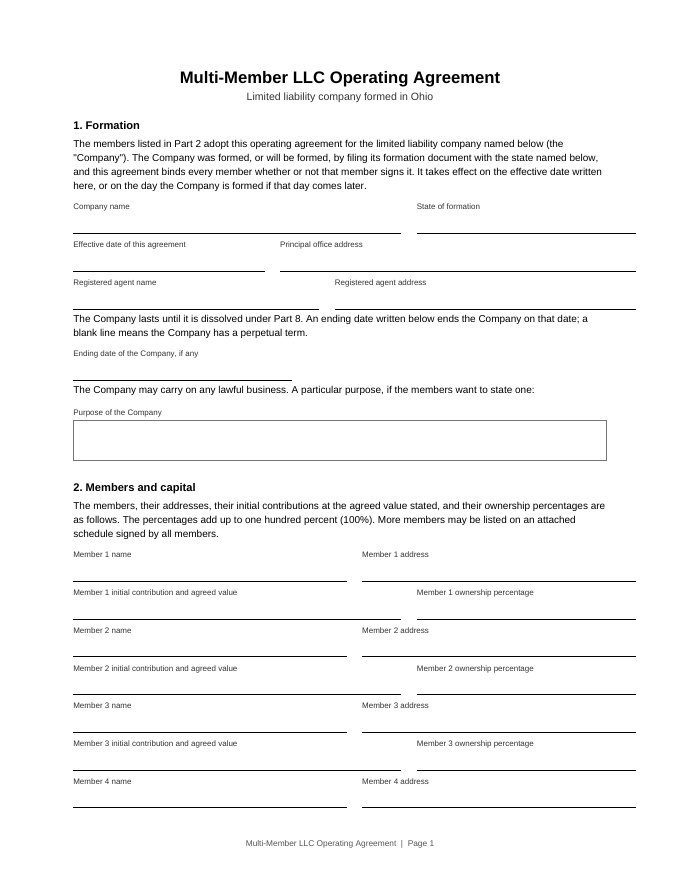
Two (2) rows carry the most weight. Ohio splits money per head, so in a two-member company the member who put in ninety percent (90%) of the capital takes half of each distribution until an agreement says otherwise; Part 3 shares by ownership percentage. And Ohio locks the door on leaving: R.C. 1706.41(A) bars voluntary dissociation, but R.C. 1706.411(A) makes “an event stated in the operating agreement” a cause of dissociation, which is how Part 8’s ninety (90) day notice works. Part 4 lists six (6) decisions that need every member’s written consent and gives the remainder to members holding above fifty percent (50%), where R.C. 1706.30(C)(1) would put every act outside the ordinary course to a unanimous vote.
Forming the company
File the articles of organization with the Secretary of State; the operating agreement never goes with them.
One or more persons form the company by executing articles of organization and delivering them to the secretary of state (R.C. 1706.16(A)). The articles state the company’s name, the name and street address of its statutory agent with the agent’s signed acceptance, a series statement where R.C. 1706.761(B)(3) applies, and anything else the organizers choose. The company is formed when the articles are filed or at a later time the articles name, up to ninety (90) days out (R.C. 1706.16(B), 1706.172(D)). The filing fee is $99 under R.C. 111.16(F), read 2026-11-01.
There is no yearly report: chapter 1706 has no annual or biennial report section, and R.C. 111.16(F) lists no report fee for a limited liability company. The articles are public notice only of the name, the agent and any series statement (R.C. 1706.16(C)); the agreement is not among the filed records. The chapter prescribes no list of books to keep, but R.C. 1706.33(A) lets a member, on reasonable notice during business hours, inspect and copy any record the company maintains that is material to the member’s rights. Part 6 of the document keeps the agreement, the articles, the contribution record and six (6) years of tax returns at the principal office.
Signing
Each member signs a block in Part 11; the manager signs the last block when the manager-managed box in Part 4 is marked.
All members named in Part 2 sign. R.C. 1706.081(B) makes a person admitted as a member a party to the agreement, so a later member is bound on admission. R.C. 1706.01(X) defines “sign” to include attaching to the record “an electronic symbol, sound, or process” with intent to adopt it, and federal law agrees: under 15 U.S.C. 7001(a)(2) a contract in or affecting interstate or foreign commerce cannot be refused effect only because it was formed with an electronic signature or record. None of R.C. 1706.01(R), 1706.08, 1706.081 or 1706.16 calls for a witness or a notary.
Federal tax
Under Treasury Regulation § 301.7701-3(b)(1)(i) a domestic eligible entity with two (2) or more members is a partnership for federal income tax unless it elects otherwise. The partnership box in Part 6 records that default; the second box is marked once the company files Form 8832 to be taxed as a corporation or Form 2553 to be taxed as an S corporation. A partnership files Form 1065, and Form SS-4 is the application for an employer identification number.
Without an agreement
R.C. 1706.08(A)(2) says that to the extent an operating agreement does not provide for a matter among the members, “this chapter governs the matter”. The members then share equally, decide ordinary matters by head count, may not voluntarily dissociate, and need every member’s consent to amend the agreement or to admit a member by vote. Limited liability survives the gap: R.C. 1706.26 says a member is not liable for the company’s debts solely by reason of being a member, and that a failure to observe formalities is not a factor in, or a ground for, imposing that liability. The LLC operating agreement covers a company with one owner; the multi-member operating agreement goes through the eleven (11) parts.
Frequently asked questions
Does an Ohio operating agreement have to be written?
No. R.C. 1706.01(R) counts an oral agreement of the members. However, R.C. 1706.08(B)(1) and (2) provide for expanding, restricting or eliminating fiduciary duties, and for limiting liability for breach, by a written operating agreement, and R.C. 1706.31(A) and (B) look to “a written operating agreement” or a written agreement with a member for any fiduciary duty beyond loyalty and care.
What can the agreement do to a member who never pays in?
R.C. 1706.281(A) makes a promise to contribute enforceable only if it is in a writing signed by the member, and R.C. 1706.08(C)(6) stops any agreement from waiving that. Once the promise is in writing, R.C. 1706.08(B)(5) lets the agreement reduce, subordinate, forfeit or force the sale of the defaulting member’s interest, or redeem it at an appraised value.
Is a manager liable for a decision that loses money?
R.C. 1706.311(C) asks a manager to act in good faith in a manner the manager reasonably believes to be in, or not opposed to, the company’s best interests, and R.C. 1706.311(E) allows monetary relief only for an act taken with deliberate intent to injure the company or with reckless disregard for its interests, unless the articles, the operating agreement or a written agreement between the manager and the company opt out of that division by specific reference.