

State Laws
Oregon’s act is ORS Chapter 63, the Oregon Limited Liability Company Act (63.951). The operating agreement is defined in 63.001(25) as “any valid agreement, written or oral, of the member or members as to the affairs of a limited liability company and the conduct of the limited liability company’s business”, and 63.057 says the agreement, “if any”, may regulate the company’s affairs in any manner not inconsistent with law or the articles of organization and may be written or oral. The power to adopt, alter, amend or repeal it belongs to the members, and they keep it even where the articles hand managers the same power (63.431(2), (3)); except as ORS 63.441, the articles or the agreement provide, every amendment to either document takes the unanimous approval of the members (63.444).
The limits are short and the act numbers them. Under 63.155(10) the articles or the agreement may not (a) eliminate completely the duty of loyalty, though they may identify specific types or categories of activities that do not violate it, if not unconscionable, and name who may ratify a conflicted act after full disclosure; (b) unreasonably reduce the duty of care, which 63.155(3) limits to refraining from grossly negligent or reckless conduct, intentional misconduct or a knowing violation of law; or (c) eliminate completely the obligation of good faith and fair dealing. Under 63.160 no provision may limit liability or indemnify a member or manager for (1) a breach of the duty of loyalty, (2) acts not in good faith that involve intentional misconduct or a knowing violation of law, (3) an unlawful distribution under 63.235 or (4) a transaction yielding an improper personal benefit, nor for anything done before the provision took effect. Beyond those, a promise to contribute binds only in a writing signed by the member (63.180(1)), any company record is open to any member on reasonable request (63.771(2)), the company dissolves when it has no members (63.621(4)) and creditors are paid first on winding up (63.625(1)).
The defaults the document replaces
| Rule | Oregon default | Section |
|---|---|---|
| Management | Member-managed unless the articles of organization designate the company as manager-managed or otherwise say a manager will manage it | ORS 63.001(20), (22), 63.047(1)(d) |
| Weight of a vote | In a member-managed company each member has equal rights in the management and conduct of the business, and in a manager-managed company each manager does; the act counts members and managers, not contributions | 63.130(1)(a), (2)(a) |
| Ordinary decisions | Any matter relating to the business may be decided by a majority of the members or, in a manager-managed company, exclusively by the manager or a majority of the managers | 63.130(1)(b), (2)(b) |
| Matters that take every member | Three (3): amending the operating agreement or the articles; compromising, as among the members, an obligation to contribute or to return money paid out in violation of the chapter; and consenting to dissolve | 63.130(3) |
| Matters that take a majority of members | Ten (10): interim distributions, a redemption included; admitting a new member; using company property to redeem an interest under a charging order; selling, leasing, mortgaging or otherwise disposing of substantially all property; a merger; a conversion; borrowing outside the ordinary course; a transaction involving a conflict of interest with a member or manager; a change in the nature of the business; and any other matter the articles or agreement reserve to the members without stating a number | 63.130(4) |
| Choosing or removing a manager | Designated, elected, removed or replaced by a majority of the members; need not be a member; holds office until a successor is elected and qualified unless the manager sooner resigns or is removed | 63.130(2)(c), 63.001(19) |
| Meetings and proxies | Any action requiring the consent of members or managers may be taken without a meeting; a member or manager may appoint a proxy by signing an appointment instrument | 63.130(5), (6) |
| Profits and losses | Allocated equally among all the members; where only profits are allocated, losses follow them, and the reverse | 63.185(2), (3) |
| Distributions before dissolution | In proportion to each member’s right to share in profits, at the times the articles or agreement specify; a member may demand cash only and cannot be forced to take a disproportionate share in kind | 63.195, 63.200, 63.219 |
| Transfer of an interest | Assignable in whole or in part; until admitted, the assignee receives and retains the assigned distributions and allocations of profits and losses but exercises no other right of a member, the vote included; a person is admitted as a member on compliance with the articles or the agreement and, if neither provides, a person acquiring an interest directly from the company on the consent of a majority of the members, an assignee on the consent of a majority of the members other than the assignor, and the assignee of the last member’s interest simultaneously with the assignment | 63.249(1), (3), 63.245(2) |
| Withdrawal | At the time or on the events the articles or agreement specify, or on not less than six (6) months’ prior written notice unless the articles or agreement expressly limit or condition the power; unless the articles or the agreement provide otherwise, a withdrawal in breach lets the company recover damages and offset them, and leaving before a definite term ends is a breach | 63.205 |
| What a dissociated member gets | The holder of the former member’s interest is an assignee with an assignee’s rights, duties and obligations; no section orders the company to buy the interest | 63.265(2)(a) |
| A member’s death | Unless the articles or the operating agreement provide otherwise, death, incompetency, bankruptcy, dissolution, withdrawal, expulsion or assignment of the entire interest ends membership; the holder of the interest is an assignee, except that the holder of the last member’s interest becomes a member at once | 63.265(1), (2) |
| Dissolution | The first of: the time stated in the articles; an event the articles or agreement specify; the members’ vote as the articles or agreement provide, otherwise the consent of all members; the moment the company has no members; administrative dissolution; a judgment of judicial dissolution | 63.621 |
| Order of payment on winding up | To the extent permitted by law, creditors first, members and former members who are creditors included; then, except as the articles or agreement provide, distributions already due, then the return of unreturned contributions, then the members’ shares in profits | 63.625 |
| Ceiling on distributions | A distribution may be made only if, in the judgment of the members or managers, the company can still pay its debts as they become due in the ordinary course and the fair value of its total assets at least equals its total liabilities plus, unless the articles permit otherwise, the preferential rights of other members on dissolution | 63.229(1) |
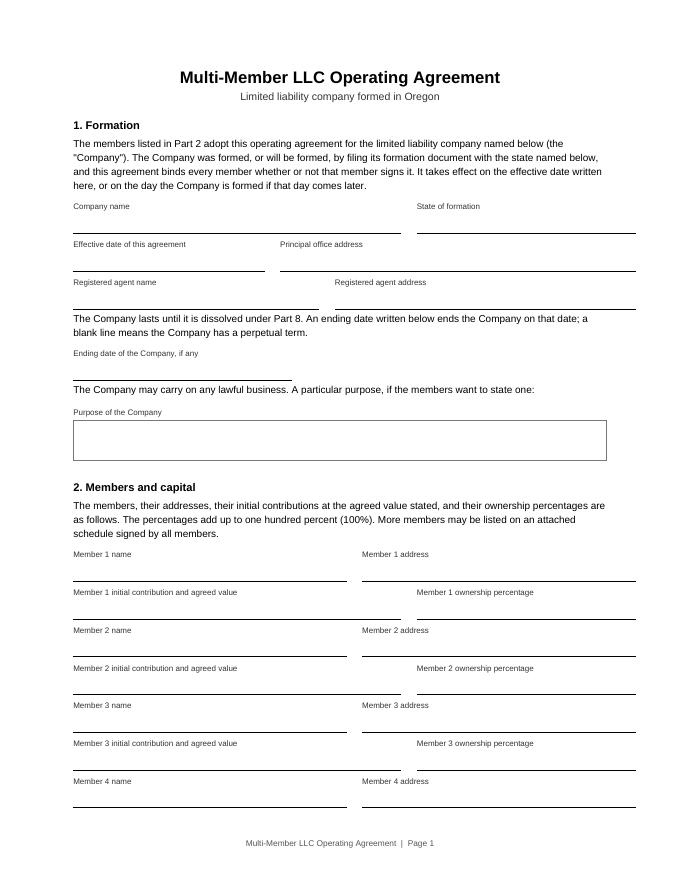
Part 5 of the document counts votes by ownership percentage where 63.130(1)(a) counts heads, Part 3 shares profits, losses and every distribution by the same percentages where 63.185(2) and 63.195 share equally, and Part 4 moves five (5) items from the majority list of 63.130(4) to the written consent of all members; each of those rules yields to the articles of organization or any operating agreement (63.130(1), (4), 63.185(1), (2), 63.195), except that the vote for a merger or a conversion is a floor: the plan is approved “by a majority vote of its members, or by a greater vote if required by its articles of organization or any operating agreement” (63.487(1)(a), 63.473(1)(a)). The ceiling stays as the act writes it. A member who votes for or assents to a distribution that violates 63.229, the articles or the agreement is personally liable to the company for the excess if it is established that the member did not perform the duties in 63.155, and a proceeding is barred two (2) years after the distribution (63.235(1), (4)).
Forming the company
File articles of organization with the Corporation Division of the Secretary of State, online through the Business Registry or by mail to 255 Capitol St. NE, Suite 151, Salem, OR 97310, with the $100 fee; keep the operating agreement at the office the agreement names.
One or more individuals of eighteen (18) years or older, or other entities, form the company by signing and delivering articles of organization; organizers need not be members, and existence begins on filing or on a delayed date no later than the ninetieth (90th) day after it (63.044, 63.051(1), 63.011(2)). The articles set forth nine (9) items under 63.047(1), among them a name containing “limited liability company”, “L.L.C.” or “LLC” (63.094(1)), a registered agent at a physical street address in Oregon (63.111(1)), a statement that the company will be manager-managed if it will, the latest date on which it will dissolve or a statement that its existence is perpetual, the street address of the principal office, and the name and address of at least one (1) member, manager or authorized representative with direct knowledge of its operations. One or more persons intending to form the company sign the articles and declare, under penalty of perjury, that the document does not misrepresent anyone’s identity (63.004(2)(a)(A), (b)(A)). The fee is the one 63.007 borrows from ORS 56.140: one hundred dollars for articles of organization, nonrefundable (56.140(1)(d)). The Secretary of State’s Business Registry Fee Schedule, linked from the Corporation Division’s business registration forms page and read 2026-11-04, lists Articles of Organization for a domestic limited liability company at $100.00, Articles of Amendment/Dissolution at $100.00, Renewal (Annually) at $100.00 and a change of registered agent or address at no charge.
The annual report is due every year by the company’s anniversary, the day exactly one or more years after the Secretary of State filed its articles (63.787(1), 63.001(1)). It names the registered office and agent, the principal office, the managers of a manager-managed company or at least one member of a member-managed one, and the primary business activity, current as of thirty (30) days before the anniversary; the Secretary mails the form, but not receiving it excuses nothing (63.787(1) to (3)). The fee is one hundred dollars (56.140(2)), and the Corporation Division’s Start a Business guide, read 2026-11-04, says the office sends a renewal notice about forty-five (45) days before the renewal date, “the anniversary of your registration”. A company that does not deliver its report when due, or does not pay a fee the chapter imposes, may be administratively dissolved: it gets written notice and forty-five (45) days to correct the ground, then exists only to wind up, and may apply for reinstatement within five (5) years (63.647(1), (2), 63.651(2), (3), 63.654(1)). Chapter 63 and 56.140 as read set no late fee and no publication requirement.
Nothing in the chapter sends the operating agreement to the Secretary of State. 63.771(1) has the company keep, at an office the operating agreement specifies or otherwise at the registered office, the past and present lists of members and managers, the articles with any powers of attorney behind an amendment, three (3) years of tax returns and financial statements, every written operating agreement in force with its amendments and, unless a written agreement contains it, a statement certified by a manager of what each member contributed and promised to contribute. Any company record is open to inspection and copying at the reasonable request, and at the expense, of any member during ordinary business hours; the member’s agent or attorney has the same right, and the circuit court may order an inspection the company refuses and make it pay the member’s costs unless it proves it refused in good faith because it had a reasonable basis for doubt about the member’s right to inspect (63.771(2), 63.777(1), 63.781(1), (3)). Part 6 of the document keeps those records and every other record the act requires at the principal office, open to every member with no purpose to state.
Signing
Every member in Part 2 signs one of the four blocks in Part 11; the manager signs the fifth block when Part 4 marks the company manager-managed.
Every member signs. The act’s agreement is one “of the member or members” (63.001(25)), the members hold the power to adopt and amend it (63.431(2)) and each amendment takes all of them unless the agreement says otherwise (63.444); a person becomes a member on the later of the day the articles are filed or the date the company’s records give (63.245(1)). No notary or witness is named in 63.004, 63.057, 63.431, 63.444 or 63.771, or anywhere else in the chapter as read in full on 2026-11-04; the only acknowledgment the chapter lets a signed document carry is one a filed document “may include” (63.004(1)(b)(E)), and the agreement is not filed. An electronic signature on the agreement is covered by 15 U.S.C. 7001(a)(2): a contract relating to a transaction in interstate commerce may not be denied legal effect, validity or enforceability solely because an electronic signature or electronic record was used in its formation.
Federal tax
A domestic eligible entity with two (2) or more members is a partnership for federal income tax unless it elects otherwise (Treasury Regulation § 301.7701-3(b)(1)(i)), and ORS 63.810 makes Oregon classify the company, and each member, the same way for the tax chapters it lists. The members, or the manager with their written consent, may elect corporation treatment on Form 8832 or S corporation treatment under section 1362(a) on Form 2553, and Part 6 of the document records which box applies. A partnership files its information return on Form 1065; the employer identification number comes from Form SS-4.
Without an agreement
With no agreement the chapter decides everything in the table: equal profit shares, equal rights for the members of a member-managed company or the managers of a manager-managed one, a majority of the members for a new member or a sale of the business, six (6) months’ notice to withdraw, and an assignee’s rights for whoever holds a departed member’s interest (63.185(2), 63.130(1), (4), 63.205(1)(b), 63.265(2)). The shield stands on its own: no member or manager is personally liable for the company’s debts, obligations or liabilities solely by reason of being or acting as one, and a failure to observe the usual formalities is not a ground for imposing personal liability (63.165(1), (2)); a member who is a professional stays liable for professional conduct as a shareholder of a professional corporation would be (63.074(2)). A company with one (1) member uses the single-member operating agreement, the writing 63.431(2) lets a sole member adopt alone; the LLC operating agreement section compares the two documents, and the multi-member operating agreement is the eleven (11) part base this Oregon version changes in four places.
Frequently asked questions
Must an Oregon operating agreement be written?
No: 63.057 and 63.001(25) accept an oral agreement. Two (2) things still need paper. A member’s promise to contribute is enforceable only if it is set out in writing and signed by that member (63.180(1)), and unless a written agreement records each member’s contributions and promised contributions, a manager must prepare and certify a statement of them for the company’s records (63.771(1)(e)).
Why does the document make the last member’s successor a member at once?
Because the chapter dissolves the company “at such time as the limited liability company has no members” (63.621(4)), with no grace period, while 63.265(2)(b) makes the holder of a sole member’s interest a member simultaneously with the member’s departure unless the agreement provides otherwise. Part 8 keeps that rule so the company survives the death of its last member, and lists “when the Company has no member” among the dissolution events in the act’s own terms.
How much notice does a member give to withdraw?
The act’s own term is not less than six (6) months’ prior written notice, unless the articles or the operating agreement expressly limit or condition the power to withdraw (63.205(1)(b)); Part 8 of the document sets ninety (90) days. Unless the articles or the agreement provide otherwise, a withdrawal that breaches the agreement, or comes before the end of a definite term, lets the company recover its damages and offset them against anything owed to the member (63.205(2), (3)).
Does the company have to file articles of dissolution?
63.631 says a dissolved company “may” deliver articles of dissolution stating its name and the date of dissolution, so the filing is optional, and the fee schedule prices Articles of Amendment/Dissolution at $100.00. What the chapter does require is winding up: the managers or members pay creditors first under 63.625 and may give known claimants written notice that bars late claims (63.637(3), 63.641).