

State Laws
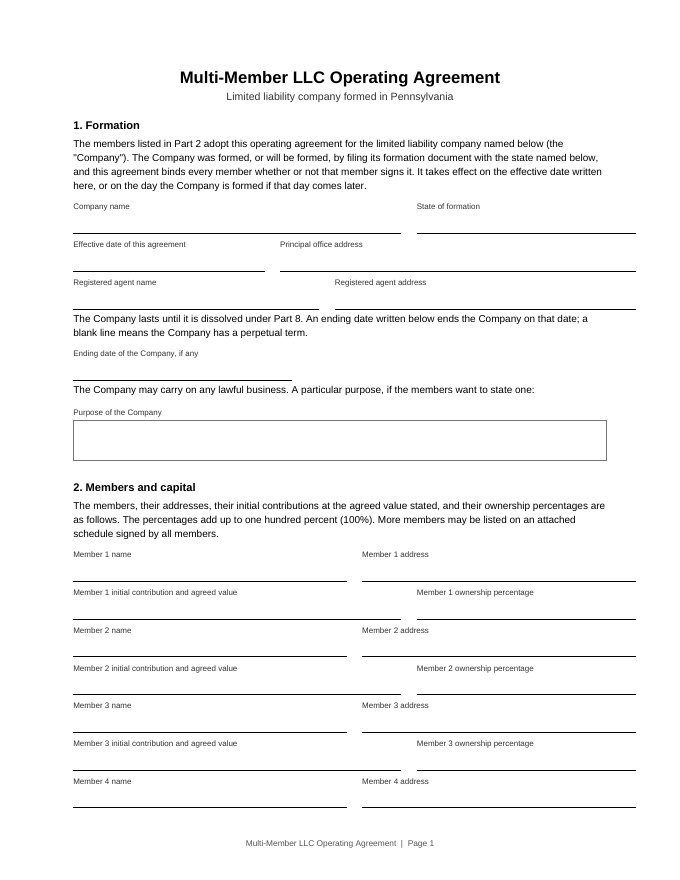
Pennsylvania’s act is the Pennsylvania Uniform Limited Liability Company Act of 2016, chapter 88 of Title 15 (§ 8811(a)). No section read on 2026-11-01 orders the members to adopt an operating agreement or to write one down. § 8812 defines the term as the agreement of all the members, a sole member included, “whether oral, implied, in record form or in any combination thereof”. The company is bound by it whether or not the company itself assented (§ 8816(a)), and a person who becomes a member is deemed to assent (§ 8816(b)). Under § 8817(e), if an operating agreement in record form provides that it cannot be amended, modified or rescinded except in record form, an oral agreement, amendment, modification or rescission is not enforceable. Part 10 of the document says that.
§ 8815(c) lists twenty (20) things an operating agreement may not do. Among them: the registered office and filing rules ((c)(9)), the limits on indemnification in § 8848(g) ((c)(10)), the duties of loyalty and care ((c)(11), (12)), the obligation of good faith and fair dealing ((c)(13)), the information rights of § 8850 ((c)(14)), judicial dissolution ((c)(15)) and the winding-up duties of § 8872 ((c)(16)). Subsection (d) then lets the agreement alter the duty of care “if not manifestly unreasonable” ((d)(3)), impose reasonable restrictions on the availability and use of information ((d)(1)(iii)) and soften the balance-sheet test of § 8845(a)(2) to total assets not less than total liabilities ((d)(1)(ii)).
The defaults the document replaces
| Rule | Pennsylvania default | Section |
|---|---|---|
| Management | Member-managed, unless the agreement expressly says the company is manager-managed, is managed by managers, or that management is vested in managers | § 8847(a) |
| Weight of a vote | Each member has equal rights in management and conduct; each manager likewise in a manager-managed company | § 8847(b)(2), (c)(2) |
| Ordinary decisions | A majority of the members; in a manager-managed company the manager, or a majority of the managers | § 8847(b)(3), (c)(1) |
| Acts outside the ordinary course | The affirmative vote or consent of all members | § 8847(b)(4), (c)(3)(i) |
| Admitting a member | After formation, by the consent of all the members, or in the way the agreement sets | § 8841(d)(2), (4) |
| Amending the agreement | The affirmative vote or consent of all members | § 8847(b)(6), (c)(3)(iii) |
| Choosing or removing a manager | A majority of the members, at any time, without notice or cause | § 8847(c)(4) |
| Sharing of distributions | In equal shares among members and dissociated members and, apart from the election in § 8844(e), only when the company decides to make an interim distribution | § 8844(a), (b), (e) |
| Transfer of an interest | Permitted; the transferee has the right to receive, in accordance with the transfer, the distributions the transferor would otherwise be entitled to, and the transfer does not entitle the transferee to participate in management or, except as § 8852(c) provides and subject to § 8854, to have access to records | § 8852(a), (b), (c) |
| Withdrawal | A member may withdraw by express will at any time, but a withdrawal before winding up is complete is wrongful and the member is liable for the damages the dissociation causes | § 8862(a), (b)(2)(i), (c) |
| A member’s death | The member is dissociated; the personal representative may claim a transferee’s account on dissolution and use the information rights to settle the estate | § 8861(7)(i), § 8854 |
| Vote to dissolve | The consent of all the members; also 180 consecutive days with no member, unless transferees owning a majority of distribution rights consent to admit a member and one is admitted in that time | § 8871(a)(2), (3) |
| Order of payment on winding up | Creditors first, members who are creditors included; then the value of unreturned contributions; then the owners of transferable interests in proportion to their distribution rights, all paid in money | § 8877(a), (b), (d) |
| Ceiling on distributions | None after which the company could not pay its debts as they become due, or its total assets would fall below its total liabilities plus the preferential rights of senior members and transferees | § 8845(a) |
Part 5 of the document weighs votes by ownership percentage and lets holders of more than fifty percent (50%) decide ordinary matters, Part 4 reserves six (6) acts to the written consent of all members, and Part 3 shares profits and distributions by percentage instead of per head. The ceiling stays, with teeth: under § 8846(a) a member or manager who consents to a distribution that breaks § 8845 and fails the standards of conduct in § 8849.1 or § 8849.2 owes the company the excess, and an action under § 8846 is barred unless commenced within two (2) years after the distribution (§ 8846(e)).
Forming the company
Deliver the certificate of organization to the Department of State with the fee; the operating agreement stays at the office.
One or more associations or individuals 18 years of age or older act as organizers and form the company by delivering a certificate of organization to the department (§ 8821(a)). The certificate needs only two (2) statements, the company’s name and the address of its registered office or the name of a commercial registered office provider under § 109 (§ 8821(b)), and the company exists when the certificate becomes effective (§ 8821(f)). The fee is $125 under 15 Pa.C.S. § 153(a)(3)(i), read 2026-11-01.
The annual report requirement of § 146 took effect on January 3, 2024 (§ 146(h)). § 146(a) requires an annual report stating the company’s name and jurisdiction, registered office, the name of at least one governor, its principal officers if any, its principal office address and its entity number; § 146(c)(2) makes a limited liability company’s report due before October 1, starting with the calendar year after the company became subject to the section. The fee is $7, electronic or paper (§ 153(a)(18)(ii), (iii)), and $0 for a company with a not-for-profit purpose.
Nothing in chapter 88 sends the operating agreement to Harrisburg; § 8821(b) requires the certificate of organization to state only the company’s name and its registered office address. Chapter 88 names no list of records to keep; what it gives is access. In a member-managed company § 8850(a)(1) lets a member inspect and copy, on reasonable notice during business hours, any record the company maintains; in a manager-managed company § 8850(b)(2) asks for a demand in record form stating a purpose, and the company has ten (10) days to answer (§ 8850(b)(3)). Part 6 of the document keeps the agreement, the certificate, the contribution record and six (6) years of tax returns at the principal office.
Signing
All four member blocks in Part 11 are signed; the manager signs the fifth block when the manager-managed box in Part 4 is marked.
Every member listed in Part 2 signs. The act makes the agreement the agreement of all the members (§ 8812), binds the company without its own signature (§ 8816(a)) and deems a later member to have assented on admission (§ 8816(b)). Neither § 8812 nor §§ 8815 to 8817 mentions a notary or a witness. Electronic signing rests on 15 U.S.C. 7001(a)(2): where a transaction is in or affects interstate or foreign commerce, the use of an electronic signature or record is not by itself a reason to deny a contract legal effect.
Federal tax
Treasury Regulation § 301.7701-3(b)(1)(i) classifies a domestic eligible entity with two (2) or more members as a partnership unless it elects otherwise. The members mark that default in Part 6, or mark the second box after filing Form 8832 to be taxed as a corporation or Form 2553 as an S corporation. A partnership reports its income on Form 1065, and an employer identification number is applied for on Form SS-4.
Without an agreement
§ 8815(b) is the rule: to the extent the operating agreement does not provide for a matter, “this title governs the matter”. A company with no agreement therefore shares every distribution per head, needs every member’s consent for any act outside the ordinary course and makes a member who withdraws before winding up is complete liable for the damages the dissociation causes. Limited liability does not depend on it: § 8834(a) makes a debt of the company solely the company’s and says a member or manager is not personally liable by reason of that status alone, with one member or many. The LLC operating agreement covers a company with one owner, and the multi-member operating agreement goes through the document part by part.
Frequently asked questions
Can a member be paid for working in the business?
In a member-managed company, not by default. § 8847(h) says a member of a member-managed company is not entitled to remuneration for services, apart from reasonable compensation for winding up. Part 3 of the document says only that reasonable compensation for services is not a distribution, which matches the definition in § 8812; salaries are for the members to agree.
What if a member puts in more money than the agreed contribution?
§ 8847(f) makes the company reimburse an advance beyond the agreed capital, and § 8847(g) treats the advance as a loan that accrues interest from the day it was made. Part 2 of the document keeps a true contribution separate: additional contributions happen only under a writing signed by all members, and no interest accrues on a contribution.
Can the other members expel a member?
Yes. § 8861(4) allows expulsion under the operating agreement; § 8861(5) allows it by the consent of all the other members in the cases it lists, among them a transfer of the whole transferable interest; and § 8861(6) allows it by court order for wrongful conduct that adversely and materially affects the company, a willful or persistent material breach of the operating agreement or of a member’s duties, or conduct that makes it not reasonably practicable to carry on with the person as a member.