

State Laws
South Carolina’s act is Chapter 44 of Title 33, cited as the South Carolina Uniform Limited Liability Company Act of 1996 (33-44-1202). Nowhere in the chapter as read on 2026-11-03 are the members told to adopt an operating agreement. 33-44-103(a) says all members “may enter into an operating agreement, which need not be in writing”, to regulate the affairs of the company and the conduct of its business and to govern relations among the members, managers and company; to the extent the agreement does not otherwise provide, the chapter governs those relations. 33-44-101(13) defines the agreement as the one made under 33-44-103, amendments included.
33-44-103(b) names seven (7) things the agreement may not do: unreasonably restrict a right to information or access to records under 33-44-408; eliminate the duty of loyalty under 33-44-409(b), though it may identify activities that do not violate it and set who may ratify a specific act after full disclosure; unreasonably reduce the duty of care under 33-44-409(c); eliminate the obligation of good faith and fair dealing under 33-44-409(d); vary the right to expel a member in an event in 33-44-601(6); vary the requirement to wind up in a case in 33-44-801(3) or (4); or restrict the rights under the chapter of a person other than a manager, member and transferee. Where the articles and the agreement conflict on any other matter, the agreement controls as to managers, members and transferees while the articles control as to outsiders who reasonably rely on them to their detriment (33-44-203(c)).
The defaults the document replaces
| Rule | South Carolina default | Section |
|---|---|---|
| Management | Member-managed, unless the articles of organization designate the company as manager-managed and name each initial manager | S.C. Code 33-44-101(11), (12), 33-44-203(a)(6) |
| Weight of a vote | Each member has equal rights in the management and conduct of the company’s business; in a manager-managed company each manager has equal rights | 33-44-404(a)(1), (b)(1) |
| Ordinary decisions | Any matter relating to the business may be decided by a majority of the members or, in a manager-managed company, exclusively by the manager or a majority of the managers, apart from the matters in subsection (c) | 33-44-404(a)(2), (b)(2) |
| Matters that take every member | Twelve (12) only: amending the operating agreement; authorizing or ratifying an act that would violate the duty of loyalty; amending the articles; compromising a contribution obligation; compromising, as among members, an obligation to return money paid in violation of the chapter; making interim distributions, a redemption included; admitting a new member; using company property to redeem an interest subject to a charging order; consenting to dissolve under 33-44-801(2); waiving the winding up under 33-44-802(b); merging; and selling, leasing or exchanging all or substantially all of the company’s property | 33-44-404(c) |
| Choosing or removing a manager | Designated, appointed, elected, removed or replaced by a vote, approval or consent of a majority of the members; holds office until a successor is elected and qualified unless the manager sooner resigns or is removed | 33-44-404(b)(3) |
| Meetings and proxies | Action requiring the consent of members or managers may be taken without a meeting; a member or manager may appoint a proxy by signing an appointment instrument | 33-44-404(d), (e) |
| Sharing of distributions | In equal shares; no member has a right to receive, or may be required to accept, a distribution in kind | 33-44-405(a), (b) |
| Transfer of an interest | A distributional interest is personal property and may be transferred in whole or in part; the transferee receives only the distributions the transferor would have received and becomes a member only if the transferor had that authority under the agreement or all other members consent; a transferee who is not a member may not take part in management, require information or inspect records | 33-44-501(b), 33-44-502, 33-44-503(a), (d) |
| Withdrawal | Unless the agreement provides otherwise, a member may dissociate at any time, rightfully or wrongfully, by express will; the dissociation is wrongful if it breaches an express provision of the agreement, the member is liable for the damages, and the damages are offset against distributions due after the dissociation | 33-44-602(a) to (d) |
| Buyout of a dissociated member | In an at-will company the company must cause the dissociated member’s distributional interest to be purchased at its fair value as of the dissociation date; it delivers a purchase offer with a statement of assets and liabilities within thirty (30) days, and if no agreement is made within one hundred twenty (120) days the member has another one hundred twenty (120) days to sue to enforce the purchase | 33-44-603(1), 33-44-701(a) to (d) |
| A member’s death | The member is dissociated and is treated the same as a transferee; the company must furnish the legal representative of a deceased member the information a member could require | 33-44-601(8)(i), 33-44-603(3), 33-44-408(b) |
| Dissolution | On an event the agreement specifies; on the consent of the number or percentage of members the agreement specifies, a consent that otherwise takes every member; on an event that makes the business unlawful, unless cured within ninety (90) days; or on a court decree on a member’s, dissociated member’s or transferee’s application | 33-44-801, 33-44-404(c)(9) |
| Order of payment on winding up | Creditors first, members who are creditors included; then the surplus paid in money to the members according to their right to distributions or, where the company is required to maintain capital accounts as the Internal Revenue Code contemplates, according to their positive capital account balances | 33-44-806 |
| Ceiling on distributions | None after which the company could not pay its debts as they become due in the ordinary course of business, or its total assets would be less than its total liabilities plus the amount needed on dissolution to satisfy the preferential rights of members whose rights are superior to those receiving the distribution | 33-44-406(a) |
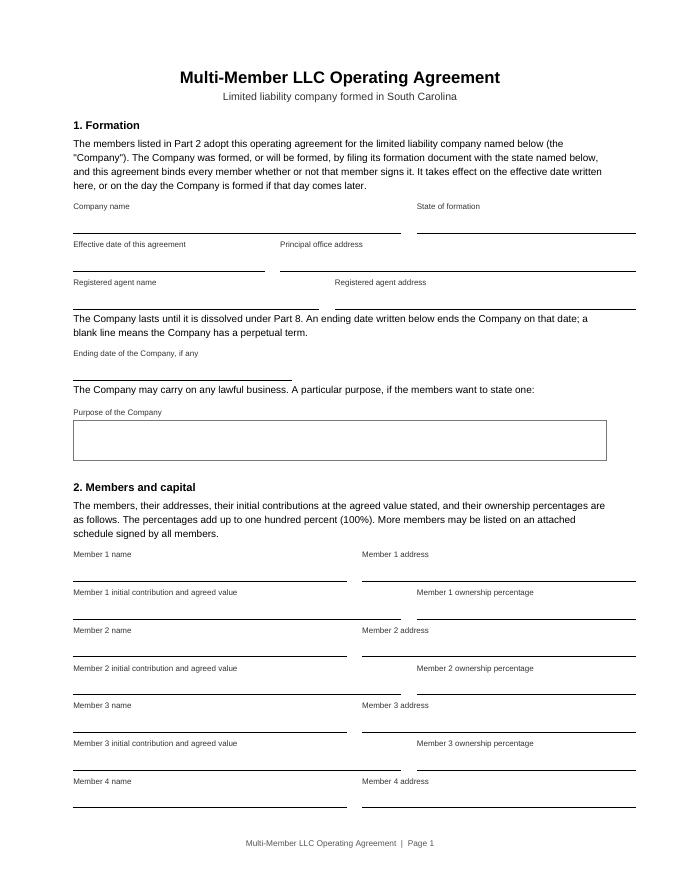
Part 5 of the document weighs votes by ownership percentage and Part 3 shares profits, losses and distributions the same way, where 33-44-405(a) splits equally and 33-44-404(c)(6) would hold every interim distribution for the consent of all members; Part 4 keeps six (6) acts for the written consent of all members, fewer than the twelve (12) in 33-44-404(c), none of which 33-44-103(b) protects. The last row stays. A member or manager who votes for or assents to a distribution made in violation of 33-44-406, the articles or the agreement is personally liable to the company for the excess if it is established that the duties in 33-44-409 were not performed; a member of a manager-managed company who knew the distribution was unlawful is liable to the extent of the excess received; and a proceeding is barred two (2) years after the distribution (33-44-407(a), (b), (d)).
Forming the company
Deliver articles of organization to the Secretary of State with the $110 fee; keep the operating agreement at the principal office.
One or more persons organize the company by delivering articles of organization to the Secretary of State; its existence begins when the articles are filed unless they name a delayed effective date, which may not fall later than the ninetieth (90th) day after filing (33-44-202(a), (b), 33-44-206(d)). The articles set forth seven (7) items: the name, which under 33-44-105(a) must contain “limited liability company” or an abbreviation such as “LLC”; the address of the initial designated office; the name and street address of the initial agent for service of process; the name and address of each organizer; whether the company is a term company and, if so, the term; whether it is manager-managed and, if so, each initial manager’s name and address; and whether any member is to be liable for its debts under 33-44-303(c) (33-44-203(a)). A record filed for the company is signed in its name by a manager, a member of a member-managed company or, before formation, an organizer (33-44-205(a)). The fee is one hundred ten dollars (33-44-1204(a)(1)), and the Secretary of State’s Business Entities Online forms page, read 2026-11-03, lists Articles of Organization under 33-44-202 and 33-44-203 at $110.00. The same section prices articles of termination at $10 and reinstatement after administrative dissolution at $25 (33-44-1204(a)(10), (11)).
Chapter 44 contains no annual report. The only “annual” filing in 33-44-1204 is a foreign company’s name registration, and the Secretary of State’s business entities FAQ says business corporations file annual reports with the Department of Revenue. What the chapter does carry is administrative dissolution: the Secretary of State may begin a proceeding if the company does not pay a fee, tax or penalty imposed by the chapter or other law within sixty (60) days after it is due, the company then has sixty (60) days after service of the notice to correct the ground, and a dissolved company may apply for reinstatement within two (2) years with a Department of Revenue certificate that all its taxes are paid (33-44-809, 33-44-810(b), 33-44-811(a)).
The operating agreement is not filed. 33-44-408(a) requires the company to give members and their agents and attorneys access to its records, if any, at the company’s principal office or other reasonable locations the agreement specifies, to inspect and copy during ordinary business hours; former members get access for proper purposes to records of the period when they were members. Without demand, the company furnishes a member, and the legal representative of a deceased member, the information the member’s rights and duties reasonably require, and on demand any other information about the business unless the demand is unreasonable (33-44-408(b)); a copy of any written operating agreement comes on written demand at the company’s expense (33-44-408(c)). Part 6 of the document keeps the agreement, the articles, the member list, the contribution record, six (6) years of tax returns and three (3) years of financial statements at the principal office, and lets any member inspect them with no purpose stated.
Signing
Members sign the four blocks of Part 11, one apiece; the manager of a manager-managed company signs the fifth.
Every member in Part 2 signs. The agreement is one “all members” may enter into (33-44-103(a)), and its amendment is among the matters that take the consent of all of them (33-44-404(c)(1)). To “sign” means to identify a record by a signature, mark or other symbol with intent to authenticate it (33-44-101(17)). No notary or witness appears in 33-44-101, 33-44-103, 33-44-203 or 33-44-205, nor anywhere else in the chapter as read whole on 2026-11-03; 33-44-205(c) lets an attorney-in-fact sign a record to be filed, with the power of attorney retained by the company rather than filed. Under 15 U.S.C. 7001(a)(2), a contract touching interstate commerce keeps its legal effect even though an electronic signature or electronic record was used to form it.
Federal tax
Treasury Regulation § 301.7701-3(b)(1)(i) makes a domestic eligible entity with two (2) or more members a partnership for federal income tax unless it elects otherwise, and 33-44-201 makes the company a legal entity distinct from its members except as 12-2-25 provides for single-member companies. Form 8832 lets an eligible entity elect its federal tax classification, and Form 2553 the S corporation election, and Part 6 of the document marks whichever applies. The partnership’s information return is Form 1065, and the employer identification number comes from Form SS-4.
Without an agreement
The second sentence of 33-44-103(a) is the fallback: to the extent the agreement does not otherwise provide, “this chapter governs relations among the members, managers, and company”. A company with no agreement therefore pays equal shares, waits for every member before any interim distribution or new member, and, if it is an at-will company, must buy out anyone who dissociates at fair value on the timetable of 33-44-701. Limited liability holds either way: the company’s debts are solely the company’s, no member or manager is personally liable for them solely by reason of being or acting as one, and skipped formalities are not a ground for personal liability (33-44-303(a), (b)); the one exception is a provision in the articles making named members liable, binding only a member who consented in writing (33-44-303(c)). A company owned by one person starts from the single-member version of the LLC operating agreement; the multi-member operating agreement sets out the eleven (11) parts of the four-member document.
Frequently asked questions
Why does the document say the company need not buy a departing member’s interest?
Because the chapter would otherwise require it. 33-44-603(1) and 33-44-701(a)(1) make an at-will company purchase a dissociated member’s distributional interest at fair value, and 33-44-701(c) and 33-44-801(4)(d) let the operating agreement modify or supersede that purchase. Part 8 of the document does so and gives the remaining members a one hundred eighty (180) day option to buy at fair value instead.
Is a company with an ending date a term company?
Only if the articles say so. 33-44-101(19) defines a term company as one whose members have agreed to remain members until a term “specified in the articles of organization” expires, and 33-44-203(a)(5) asks the articles whether the company is a term company. An ending date written only in Part 1 of the document is an event the agreement specifies for dissolution under 33-44-801(1).
Can a member be paid a salary?
Not as of right. 33-44-403(d) gives a member no claim to remuneration for services to the company apart from reasonable compensation for winding up its business, so pay is a term the members set. 33-44-403(a) does require the company to reimburse a member or manager for payments made in the ordinary course of the business or to preserve its property, and such a payment is a loan that carries interest from the day it was made (33-44-403(c)).