

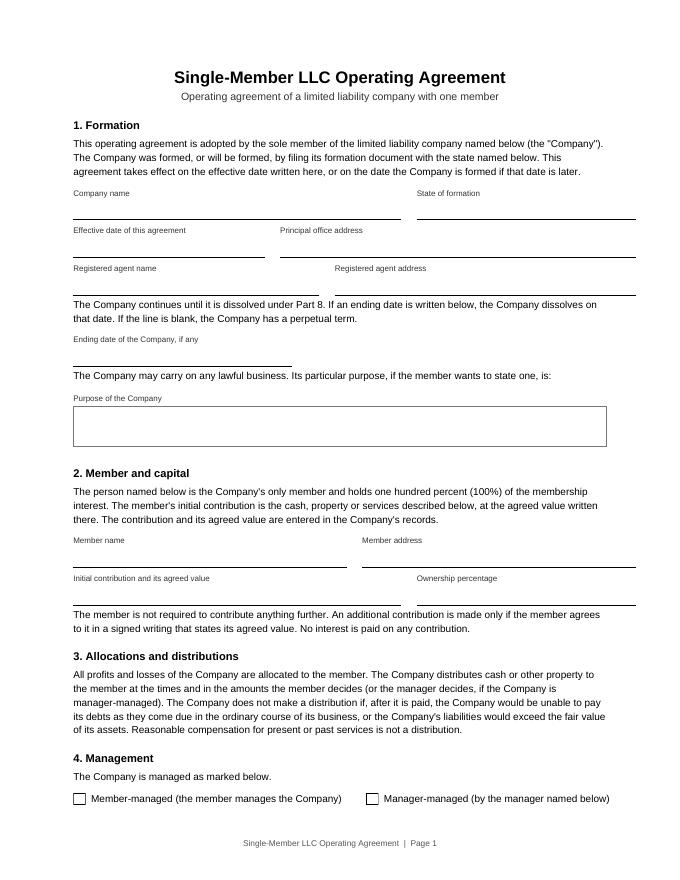
Is a written agreement required for one member?
New York is the state that insists. LLC Law § 417(a) directs “the members” of every limited liability company to adopt a written operating agreement, with no carve-out for a company of one, and § 417(c) allows it to be entered into before, at the time of, or within ninety (90) days after the articles of organization are filed. Ohio § 1706.01(R) counts “any written declaration of the sole member” as the operating agreement, and Virginia § 13.1-1023(A)(2)(a) treats any writing signed by the one member about the company’s affairs as part of it.
Florida and Texas do not require a written agreement, and Delaware § 18-201(d) asks only that an agreement be “entered into or otherwise existing”, which § 18-101(9) lets be oral or implied; each makes sure a one-party agreement holds. Delaware § 18-101(9) says an agreement of a company “having only 1 member shall not be unenforceable by reason of there being only 1 person who is a party” to it. Florida § 605.0106(5) repeats the rule, and Texas § 101.001(1) says a company agreement with one party “is not unenforceable because only one person is a party” to it. Two (2) or more owners use the multi-member operating agreement; the state-by-state rule is set out under LLC operating agreement.
What the act decides when the agreement is silent
Every blank in the agreement is filled by the state’s default rule, and for the sole member the ones that bite are management, death and what can be paid out.
| Rule | Default under the act | Section |
|---|---|---|
| Who manages | Delaware: the members, by share of profits; each member and manager may bind the company. Florida: member-managed unless the agreement or articles say otherwise. Texas: the members, unless the certificate of formation names managers | 6 Del. C. § 18-402; Fla. Stat. § 605.0407(1); Tex. BOC § 101.251(b) |
| How profits, losses and cash are shared | On the agreed value of each member’s contributions as stated in the company’s records, to the extent the company has received them | § 18-503, § 18-504; § 605.0404(1), (5); § 101.201, § 101.203 |
| A promise to put in more money | Delaware: enforceable as promised unless the agreement says otherwise. Florida: enforceable only in a writing signed by the person | § 18-502(a); § 605.0403(1) |
| Selling or giving away the interest | Assignable, but the buyer gets distributions and allocations only, with no right to manage or vote unless admitted as a member | § 18-702; § 605.0502(1); § 101.108, § 101.109 |
| Leaving the company | Texas: a member may not withdraw or be expelled; where the agreement grants a right to withdraw, § 101.205 pays the fair value of the interest. Florida: withdrawal at any time, with damages if wrongful | § 101.107, § 101.205; § 605.0601(1) to (3) |
| Death of the only member | Delaware: dissolution unless the personal representative agrees within ninety (90) days to continue the company and be admitted. Florida: dissolution after ninety (90) consecutive days with no member, unless transferees consent to admit one | § 18-801(a)(4); § 605.0701(3) |
| How much may be paid out | No distribution that leaves liabilities above the fair value of assets (Delaware, Texas), or that leaves the company unable to pay its debts as they become due or its assets below its liabilities plus preferential rights on dissolution (Florida) | § 18-607(a); § 101.206(a); § 605.0405(1) |
| Personal liability | A member or manager is not liable for a company debt solely by being one; Florida adds that skipping formalities is not a ground for liability | § 18-303(a); § 605.0304(1), (2); § 101.114 |
The death row is the one a sole owner plans around: the agreement’s Part 8 names the successor and fixes that ninety (90) day window, and Part 7 says who may buy or inherit the interest.
Signing
The member signs; a manager who is not the member signs too.
The sole member signs the agreement, and a manager named in it signs below the member. None of the sections read (Delaware § 18-101(9) and § 18-305, Florida § 605.0106 and § 605.0410, Texas § 101.052 and § 101.501) names a notary or a witness. The company itself need not sign: Delaware § 18-101(9) binds it “whether or not” it executes the agreement, and Florida § 605.0106(1) says the same. For a transaction in or affecting interstate or foreign commerce, 15 U.S.C. § 7001(a) bars denying a contract legal effect solely because an electronic signature was used.
Kept with the records, never filed
Store the signed agreement at the principal office with the formation document and the tax returns.
|
Federal tax
For income tax the company is disregarded as an entity separate from its owner under Treasury Regulation § 301.7701-3(b)(1)(ii), read on govinfo.gov, unless it files Form 8832 to be taxed as a corporation; a company that wants S corporation status files Form 2553. The IRS’s single-member LLC page (irs.gov, reviewed July 27, 2026) says an individual owner generally reports the company’s activities on Schedule C (or Schedule E or F), pays self-employment tax like a sole proprietor when the company runs a trade or business, and uses the owner’s own number for income tax when the company has no employees or excise tax liability. For employment tax and certain excise taxes the company is a separate entity with its own name and EIN, so a company with employees applies for one on Form SS-4.
What happens without an agreement
The company runs on the act. Texas § 101.052(b) applies Title 3 and Title 1 to whatever the company agreement leaves out, and Florida § 605.0105(2) says the same of chapter 605. For a single owner that means a company managed by the member (in Texas, unless the certificate of formation names managers), with no named successor, and in Delaware and Florida the ninety (90) day clock on death; Texas § 11.056(a) allows one year or the period in the company agreement.
Frequently asked questions
Can the only member also be the manager?
Yes. Delaware § 18-402 vests management in a manager “chosen in the manner provided in the limited liability company agreement”, and Florida § 605.0407(1) makes a company manager-managed when the agreement says so; neither section bars the member from being that manager.
Does the company need its own EIN?
Only for some purposes. The IRS single-member LLC page says a disregarded company with no employees and no excise tax liability may use the owner’s number for income tax, while a company with employees reports employment taxes under its own name and EIN.
What happens to the company when the member dies?
Florida § 605.0602(7)(a) dissociates an individual on death, and § 605.0701(3) dissolves the company after ninety (90) days with no member unless the transferees consent to admit someone. Delaware § 18-801(a)(4) gives the personal representative the same ninety (90) days, which the agreement may set differently.