

State Laws
Utah’s act is the Utah Revised Uniform Limited Liability Company Act, Utah Code Title 16, Chapter 20, which took that number on October 1, 2026, when Chapter 93 of the 2026 General Session moved the business entity statutes out of Title 48 and into a new Title 16. An operating agreement under 16-20-101(16) is the agreement “of all the members”, including a sole member, about the matters in 16-20-107(1): relations among the members and with the company, the rights and duties of a manager, the company’s activities and affairs, and how the agreement itself is amended. 16-20-107(2) is the gap-filler: to the extent the agreement does not provide for one of those matters, the chapter governs it. Whoever later joins as a member is treated by 16-20-108(2) as having assented to it.
The agreement runs into fourteen (14) limits in 16-20-107(3). Among them: vary the governing law (16-20-105) or the rules on registered agents and filed records; eliminate the duty of loyalty or the duty of care except as 16-20-107(4) allows; eliminate the contractual obligation of good faith and fair dealing in 16-20-409(4); relieve or exonerate a person from liability for conduct involving bad faith, willful misconduct or recklessness; unreasonably restrict the information rights of 16-20-410; vary the court-ordered causes of dissolution in 16-20-701(4)(a) and (5) or the duty to wind up in 16-20-703; or restrict the rights of a person other than a member or manager, with the exceptions of 16-20-108 and 16-20-109(2). What it may do, if not unconscionable or against public policy, is alter the duty of care short of authorizing intentional misconduct or a knowing violation of law and alter or eliminate the listed aspects of the duty of loyalty (16-20-107(4)(c)). When a filed record conflicts with the agreement, the agreement prevails as to members, dissociated members, transferees and managers, and the record prevails as to outsiders who reasonably rely on it (16-20-109(4)).
The defaults the document replaces
| Rule | Utah default | Section |
|---|---|---|
| Management | Member-managed, unless the operating agreement expressly says the company is “manager-managed”, “managed by managers”, that management is “vested in managers”, or words of similar import | Utah Code 16-20-407(1) |
| Weight of a vote | Each member has equal rights in the management and conduct of the company’s activities and affairs; in a manager-managed company each manager has equal rights | 16-20-407(2)(b), (3)(b) |
| Ordinary decisions | A difference among members on a matter in the ordinary course is decided by a majority of the members; in a manager-managed company, except as the chapter expressly provides, any matter is decided exclusively by the manager or a majority of the managers | 16-20-407(2)(c), (3)(a) |
| Matters that take every member | Any act outside the ordinary course of the company’s activities and affairs; a merger, interest exchange, conversion or domestication under Chapter 1a; amending the operating agreement; admitting a member after formation, unless the agreement provides another way, a Chapter 1a transaction makes the person a member, or transferees admit one under 16-20-701(3) (401(3)); compromising a member’s obligation to contribute; dissolving by consent; rescinding a dissolution; expelling a member on the grounds in 16-20-602(5) (the other members) | 16-20-407(2)(d) to (f), (3)(c), 16-20-401(3), 16-20-403(3)(a), 16-20-701(2), 16-20-704(2)(a), 16-20-602(5) |
| Choosing or removing a manager | Chosen at any time by the consent of a majority of the members, serving until a successor is chosen unless the manager resigns, is removed or dies; removable at any time by a majority of the members without notice or cause; need not be a member, but a member-manager who dissociates is removed as manager | 16-20-407(3)(d), (e) |
| Meetings and consents | Any action that requires a vote or consent of members may be taken without a meeting; a member may appoint a proxy or other agent by signing an appointing record | 16-20-407(4) |
| Distributions before dissolution | In equal shares among members and dissociated members, except to the extent needed to honor a transfer under 16-20-502 or a charging order under 16-20-503; only when the company decides to make an interim distribution; a dissociation entitles no one to a distribution; no one may demand a distribution in any form other than money | 16-20-404(1) to (3) |
| Transfer of an interest and the transferee’s rights | A transferable interest is personal property and may be transferred in whole or in part; the transferee receives the distributions the transferor would have received and, except for the rights 16-20-504 gives a deceased member’s legal representative, may not take part in management or see records; in a dissolution the transferee gets an account of the company’s transactions only from the date of dissolution; a transfer that violates a restriction in the agreement is ineffective as to a person with knowledge or notice of the restriction | 16-20-501, 16-20-502(1) to (3), (6) |
| Dissociation and what the member gets | A person has the power to dissociate at any time, by withdrawing by express will; a dissociation is wrongful only if it breaches an express provision of the agreement or, before winding up is complete, it is a withdrawal by express will, a judicial expulsion, a bankruptcy-type event under 602(8) or an entity member’s willful dissolution, and a person who wrongfully dissociates is liable for the damages; afterwards the person holds the transferable interest solely as a transferee (subject to 16-20-504 and to a merger, interest exchange, conversion or domestication under Chapter 1a), with no distribution on account of the dissociation | 16-20-601, 16-20-602(1), 16-20-603(1)(c), 16-20-404(2)(b) |
| A member’s death | Death dissociates an individual member; the legal representative may exercise a transferee’s right to an account and, to settle the estate, the member’s information rights | 16-20-602(7)(a), 16-20-504 |
| Dissolution events | An event, circumstance or date the certificate or agreement states; the consent of all members; ninety (90) consecutive days with no member, unless transferees holding a majority of the distribution rights admit one; a court order on a member’s petition for unlawful or impracticable business or for illegal, fraudulent or oppressive conduct by those in control; administrative dissolution by the Division | 16-20-701 |
| Winding up order | Creditors first, members who are creditors included; then an amount equal to each unreturned contribution (pro rata if the surplus falls short); then equal shares among members and dissociated members, except to the extent needed to honor a transfer under 16-20-502; the surplus steps subject to any charging order under 16-20-503 and every payment made in money | 16-20-708 |
| Records and inspection | The chapter keeps no list of required records and names no office for them; a member of a member-managed company may, on reasonable notice, inspect and copy during regular business hours any record material to the member’s rights and duties, and the company must furnish without demand what it knows is material to the proper exercise of those rights, except to the extent it can establish that it reasonably believes the member already knows it; a member of a manager-managed company inspects on a demand in a record describing the information and the purpose with reasonable particularity, for a purpose reasonably related to the member’s interest as a member, where the information is directly connected to that purpose and is as much as is just and reasonable, and the company answers in a record within ten (10) days, and must volunteer what is material whenever the member is asked to give or withhold consent | 16-20-410(1), (2) |
Part 5 of the document counts votes by ownership percentage where 16-20-407(2)(c) counts members, Part 3 shares profits, losses and distributions by the same percentages where 16-20-404(1) pays equal shares, and Part 4 lists six (6) acts for the written consent of all members in place of the open-ended “outside the ordinary course” test of 16-20-407(2)(d). The ceiling on distributions stays the act’s: none after which the company could not pay its debts as they come due, or its total assets would fall below its total liabilities plus, unless the operating agreement permits otherwise, the preferential rights owed on dissolution (16-20-405(1)). Unless the agreement has moved the authority to consent to distributions to other members (16-20-406(2)), a member or manager who consents to a distribution over that line without meeting the duties in 16-20-409 is personally liable to the company for the excess, and so is a person who knowingly receives it, for two (2) years (16-20-406(1), (3), (5)).
Forming the company
File the certificate of organization online in the Division’s Business Registration System with a UtahID and the $59 fee; keep the operating agreement with the company’s own records.
One or more organizers form the company by delivering a certificate of organization to the Division for filing (16-20-201(1)). The certificate states three (3) things for an ordinary company: the name, which under 16-1a-303(5)(a) must contain “limited liability company”, “limited company” or one of the abbreviations L.L.C., LLC, L.C. or LC; the street and mailing address of the principal office; and the registered agent information of 16-1a-404 (16-20-201(2)). The company exists when the certificate becomes effective and at least one (1) person becomes a member (16-20-201(4)); a filing takes effect when the Division files it or on a delayed date up to ninety (90) days later (16-1a-204). The Division’s Fiscal Year 2026 fee schedule, effective July 1, 2025 and read 2026-11-04, prices the LLC certificate of organization at $59 and an amendment at $17, and the Division’s domestic limited liability company page puts formations, renewals and amendments in its online Business Registration System, entered with a UtahID.
Every company then files an annual report. 16-1a-212(2) asks for the company’s name, its jurisdiction, the registered agent information, the street address of the principal office and the name and address of each director and principal officer; the report is due each calendar year on the last day of the anniversary month, meaning the month in which formation became effective, unless the Division sets a different period by rule, and may be delivered up to sixty (60) days early (16-1a-212(1), (5)(a)). The fee schedule lists the LLC renewal at $18, a figure that includes a $5 surcharge for the state’s single sign-on portal, and a late renewal fee of $10. A company that has not delivered its report within sixty (60) days after the due date can be dissolved administratively after notice and sixty (60) more days to cure (16-1a-602(2), 16-1a-603(2)); reinstatement is $54, plus $18 for each missed year and a $10 delinquency fee.
The operating agreement is never filed: 16-20-201(3) lets a certificate carry statements beyond the required three, but no section of chapter 20 lists the agreement among filings, names a required record or a place to keep one, and 16-20-410 gives access instead. Nor is there a publication step; the only published notice in the act is the optional one a dissolved company may run for other claims against it (16-20-706). Part 6 of the document keeps the agreement, the certificate, the member list, the contribution record, six (6) years of tax returns and three (3) years of financial statements at the principal office, open to every member for a purpose reasonably related to the member’s interest as a member, the test 16-20-410(2)(b)(i) itself uses.
Signing
Each member in Part 2 signs one of the four member blocks in Part 11; the manager signs the last block if Part 4 marks the company manager-managed.
Every member signs, because the agreement is by definition one “of all the members” (16-20-101(16)) and its amendment takes the consent of all of them (16-20-407(2)(f), (3)(c)(iii)). To “sign” under 16-20-101(26) is to execute or adopt a tangible symbol, or to attach an electronic symbol, sound or process to the record, with present intent to authenticate it. No notary and no witness appear in 16-20-101, 16-20-107, 16-20-108 or 16-20-201, nor anywhere else in chapter 20 as read whole on 2026-11-04; the penalty-of-perjury affirmation in 16-1a-208 attaches to entity filings, not to the agreement. For an agreement signed electronically, 15 U.S.C. 7001(a)(2) keeps a contract in interstate commerce enforceable even though an electronic signature or record was used to form it, and 16-20-1203 says the chapter modifies, limits and supersedes that federal act except for its consumer-consent rule in 7001(c), and does not authorize electronic delivery of the notices described in 15 U.S.C. 7003(b).
Federal tax
Under Treasury Regulation § 301.7701-3(b)(1)(i), a domestic eligible entity that has two (2) or more members is taxed as a partnership until it elects otherwise, and chapter 20 says nothing about classification at all. Form 8832 is the election to be classified as a corporation, a partnership or a disregarded entity, Form 2553 the election under section 1362(a) to be an S corporation, and Part 6 of the document marks either the default or the election. A company taxed as a partnership files Form 1065 and gets its employer identification number with Form SS-4.
Without an agreement
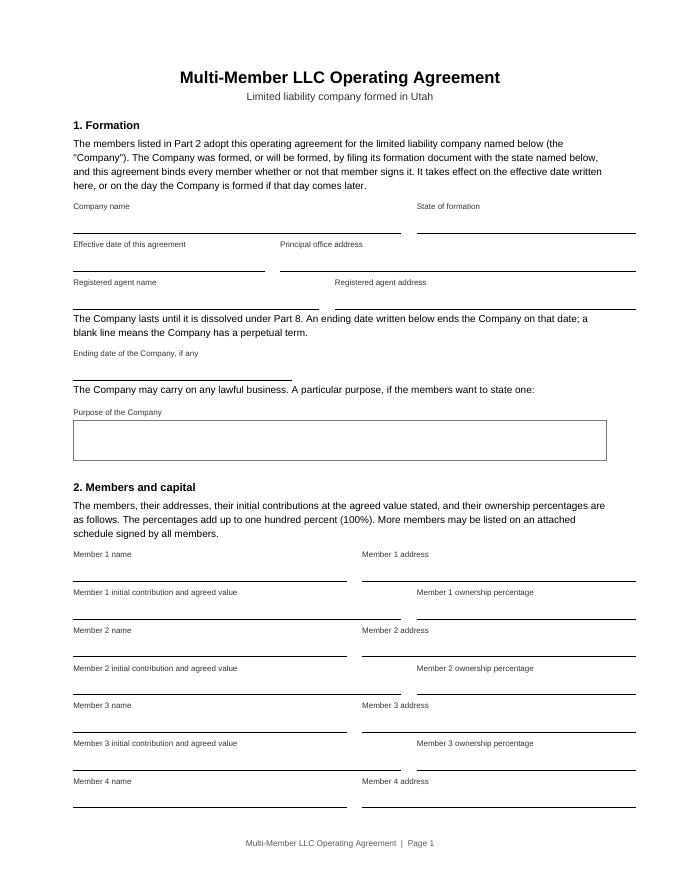
Members who never agree on anything still have a company and run it by the table above, because 16-20-107(2) makes the chapter govern each matter described in 16-20-107(1) that the agreement does not provide for. The shield is the chapter’s own and needs no agreement at all: a debt, obligation or other liability of the company is solely the company’s, no member or manager is personally liable for it solely by reason of being or acting as one, and a failure to observe formalities is not a ground for imposing liability (16-20-304). A member is not an agent of the company solely by being a member (16-20-301), so a company that wants the public record to show who may sign for it files a statement of authority under 16-20-302, which the fee schedule prices at $15. A company with one (1) owner uses the single-member operating agreement from the LLC operating agreement section; the multi-member operating agreement describes the eleven (11) parts this Utah version carries.
Frequently asked questions
Does a Utah operating agreement have to be in writing?
No. 16-20-101(16) counts an oral or implied agreement, and 16-20-107(1)(d) leaves the means of amending it to the agreement itself; Part 10 of the document allows amendment only by a writing signed by all members.
Which section numbers does the Division’s own page still use?
The old ones. The Division’s domestic LLC page, read 2026-11-04, still cites “Utah Code Ann. 48-3a-701” and “48-3a-704” for dissolution and its rescission; since October 1, 2026 those rules are 16-20-701 and 16-20-704, and the Legislature’s old 48-3a pages print “Renumbered 10/1/2026”.
Can a member be paid for working in the business?
Not by default. 16-20-407(8) gives a member of a member-managed company no right to remuneration for services, apart from reasonable compensation for winding up, so pay is a term the members write in. An advance beyond the agreed contribution is different: the company must repay it, and it is a loan that accrues interest from the day it was made (16-20-407(6), (7)).