

State Laws
Virginia’s act is Chapter 12 of Title 13.1, the Virginia Limited Liability Company Act. No section read on 2026-11-02 requires the members to adopt an operating agreement. § 13.1-1023(A)(1) lets the members enter into any operating agreement about the company’s affairs, business and member relations, binds the company whether or not it executes the agreement, and allows any provision “not inconsistent with the laws of the Commonwealth or the articles of organization”. Under § 13.1-1023(B)(1) the agreement must initially be agreed to by all of the members, and it “need not be in writing” unless the articles of organization or a written operating agreement specifically requires otherwise.
Outside Article 16 (protected series, where § 13.1-1093 lists provisions an operating agreement shall not vary), Chapter 12 has no single list of terms the agreement may not touch; its limits sit inside the sections themselves. A string of default rules applies only “unless otherwise provided in the articles of organization or an operating agreement”, and several of them insist on writing: management by managers takes a provision “in writing” (§ 13.1-1022(A)), a member may resign “only to the extent provided for in writing” (§ 13.1-1032), profits and distributions follow the agreement only where it provides “in writing” (§ 13.1-1029, § 13.1-1030).
The defaults the document replaces
| Rule | Virginia default | Section |
|---|---|---|
| Management | Vested in the members, except to the extent the articles of organization or an operating agreement provides in writing for management by one or more managers | § 13.1-1022(A), § 13.1-1024(A) |
| Weight of a vote | Members vote in proportion to their contributions, as adjusted from time to time; a majority vote is the approval of members holding a majority share of the voting power of all members | § 13.1-1022(B) |
| Ordinary decisions | Any action required or permitted to be taken by the members may be taken on a majority vote; managers act on a majority vote of the managers | § 13.1-1022(C), § 13.1-1024(G) |
| Admitting a member | A person acquiring an interest directly from the company is admitted on compliance with the agreement or, if it does not provide, on the consent of a majority of the managers of a manager-managed company or a majority vote of the members of a member-managed company | § 13.1-1038.1(A)(1) |
| Amending the agreement | All of the members must agree, unless the articles of organization or the agreement provides the manner of amendment | § 13.1-1023(B)(2), (3) |
| Selling substantially all assets | No separate vote in the sections read on 2026-11-02: § 13.1-1022(C) lets any action the members take pass by majority vote, and the articles, the agreement or a plan of merger may give dissenters’ rights for a sale of all or substantially all of the company’s assets | § 13.1-1022(C), (G) |
| Choosing or removing a manager | Elected by the members; a vacancy is filled by a majority vote of the members; if the articles and agreement are silent on removal, all or any managers may be removed with or without cause by a majority vote of the members | § 13.1-1024(D), (E), (F) |
| Sharing of distributions | On the basis of the value, as stated in the records kept under § 13.1-1028, of the contributions made by each member to the extent received; except as the same article provides, a member is entitled to interim distributions to the extent and at the times or on the events the articles or agreement specify | § 13.1-1030, § 13.1-1031 |
| Transfer of an interest | Assignable in whole or in part; an assignment does not of itself dissolve the company and, except as § 13.1-1040(A) provides, does not entitle the assignee to participate in management or to become or exercise any rights of a member; it entitles the assignee to receive, to the extent assigned, only the share of profits, losses and distributions the assignor would be entitled to; the assignee becomes a member only by a majority vote of the members other than the assignor (in a manager-managed company with member-managers, a majority of the member-managers other than the assignor), unless the articles or agreement provide otherwise in writing | § 13.1-1039(A), § 13.1-1040(A) |
| Withdrawal | A member may resign only to the extent provided for in writing in the articles of organization or an operating agreement | § 13.1-1032 |
| A member’s death | The member is dissociated; except as the articles or agreement provide, the former member’s successor in interest continues to hold the membership interest with the rights an assignee would have under § 13.1-1039(A), and the company continues without dissolution | § 13.1-1040.1(7)(a), § 13.1-1040.2 |
| Vote to dissolve | The unanimous written consent of the members; also an event specified in writing in the articles or agreement, a decree of judicial dissolution, or automatic or involuntary cancellation of the company’s existence | § 13.1-1046 |
| Order of payment on winding up | Creditors first, members who are creditors included, to the extent permitted by law; then members and former members for distributions already owed under § 13.1-1031; then members for the return of their contributions and after that in the proportions in which they share distributions, the last two unless the articles or agreement provide otherwise | § 13.1-1049 |
| Ceiling on distributions | None after which the company could not pay its debts as they become due in the usual course of business, or its total assets would be less than its total liabilities plus, unless the articles or agreement permit otherwise, the amount needed on dissolution to satisfy preferential rights ranking above those of the recipients | § 13.1-1035(A) |
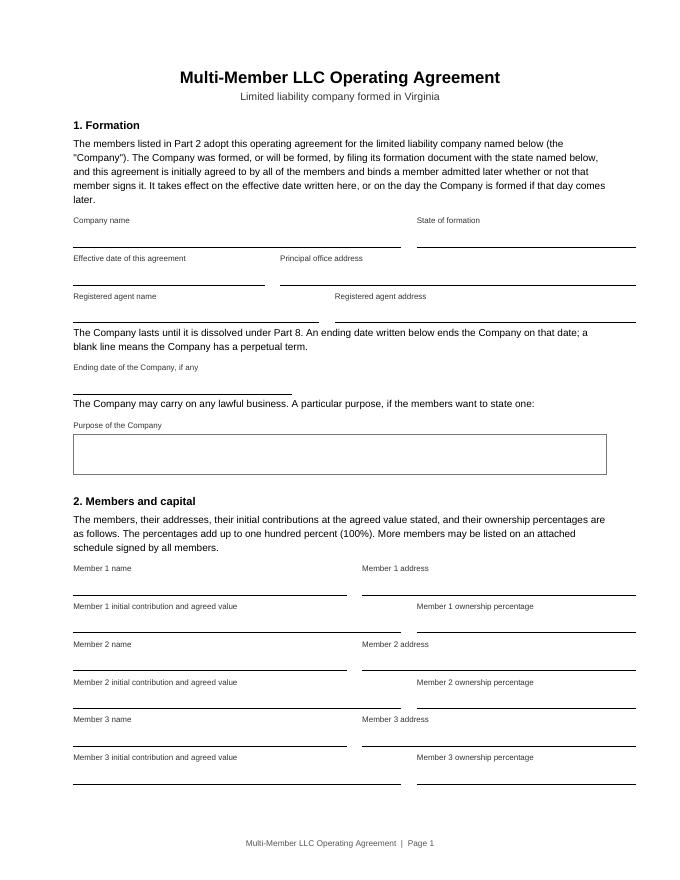
The document keeps the shape of those defaults and changes the measure. Part 5 counts votes by the ownership percentages set in Part 2 instead of by contribution value; Part 3 shares profits, losses and distributions the same way; Part 4 reserves six (6) kinds of acts to the written consent of all members where § 13.1-1022(C) would let a majority act; and Part 8 supplies the written resignation right that § 13.1-1032 says a member has only if the agreement grants it. The ceiling stays: a member who receives a distribution in violation of the agreement or § 13.1-1035 is liable to the company for it for two (2) years (§ 13.1-1036). Part 8 also leaves the court’s door open: under § 13.1-1048(B) the members may wind up a dissolved company’s affairs unless the articles or agreement provide otherwise, but the circuit court of the locality of the registered office may, on cause shown, wind them up on the application of any member, a member’s legal representative or an assignee, and may appoint one or more liquidating trustees.
Forming the company
File the articles of organization with the State Corporation Commission, online or on form LLC1011, with the $100 fee; keep the written operating agreement at the principal office or give each member electronic access to it.
One or more persons act as organizers by signing and delivering articles of organization to the State Corporation Commission (§ 13.1-1010). The articles set forth three (3) things: a name that satisfies § 13.1-1012; the post office address of the initial registered office, the city or county it is in, and the name of the initial registered agent at that office with a statement that the agent is either an individual resident of Virginia who has one of the connections to the company listed in § 13.1-1011(A)(2) or is a member of the Virginia State Bar, or a domestic or foreign stock or nonstock corporation, limited liability company or registered limited liability partnership authorized to transact business in the Commonwealth; and the post office address of the principal office, which need not be in Virginia (§ 13.1-1011(A)). The company exists from the moment the Commission issues its certificate of organization, unless a later time is specified (§ 13.1-1011(D), § 13.1-1004(B)). The filing fee is $100 (§ 13.1-1005(1)(a)); the Commission’s Virginia Limited Liability Companies forms and fees page, read 2026-11-02, lists form LLC1011 at $100.
Every domestic limited liability company pays an annual registration fee of $50 into the state treasury on or before the last day of the twelfth month after the month in which it was organized, and by that date in each year thereafter (§ 13.1-1062(A)); a company that became a limited liability company by conversion or domestication follows the dates in § 13.1-1062(A)(i), (ii), and the Commission may extend a due date by one (1) to eleven (11) months (§ 13.1-1062(C)). The Commission’s Annual Registration Fees page, read the same day, gives the same $50 and due date. A late payment adds a $25 penalty (§ 13.1-1064(A)), and a company that has not paid by the last day of the third month after its due date has its existence automatically canceled as of that day (§ 13.1-1050.2(A)); reinstatement within five (5) years costs $100 plus the fees and penalties that would have been due (§ 13.1-1050.4).
The operating agreement goes to no office. § 13.1-1028(A) lists what a company keeps at its principal office, or provides to each member as an electronic record on a network: a current list of the members; the articles and certificate of organization and amendments; income tax returns and financial statements for the three (3) most recent years; “any then-effective written operating agreement”; and, unless that agreement holds them, a writing stating each member’s contributions, when any additional contributions are due, any right to their return, and the events on which the company dissolves. Each member may inspect and copy those records on reasonable request (§ 13.1-1028(B)(1)), though a written agreement adopted by all of the members may restrict the right (§ 13.1-1028(C)). Part 6 of the document keeps every item on that list, with six (6) years of returns.
Signing
Each member signs one of the four member blocks in Part 11; the manager adds the last block when Part 4 marks the company manager-managed.
Every member in Part 2 signs. § 13.1-1023(B)(1) requires the agreement to be agreed to initially by all of the members, and the “sign” definition in § 13.1-1002 is satisfied by a tangible symbol or by an electronic symbol, sound or process attached to the record with present intent to adopt it. Nothing in § 13.1-1002, § 13.1-1003, § 13.1-1023 or § 13.1-1028 names a notary or a witness for an operating agreement. Federal law backs the electronic version: under 15 U.S.C. 7001(a)(2) a contract relating to a transaction in or affecting interstate or foreign commerce may not be denied legal effect, validity or enforceability solely because an electronic signature or electronic record was used in its formation.
Federal tax
The federal default comes from Treasury Regulation § 301.7701-3(b)(1)(i): an eligible domestic entity with at least two (2) members is taxed as a partnership until it elects a different classification. Part 6 of the document marks the partnership default in its first box; the second box follows an election on Form 8832 to be taxed as a corporation or on Form 2553 to be an S corporation. A partnership files its information return on Form 1065, and the company’s employer identification number is requested on Form SS-4.
Without an agreement
Where the members have agreed nothing, the defaults run the company: votes and distributions follow contributions, a majority of the voting power decides, no member may resign, and an assignee may become a member on a majority vote of the others. Limited liability is not conditioned on the agreement: § 13.1-1019 provides that no member, manager, organizer or other agent has any personal obligation for the company’s liabilities solely by reason of that role, except as the Code or the articles of organization expressly provide. A company with one owner uses the single-member version of the LLC operating agreement; the multi-member operating agreement sets out the four-member document clause by clause.
Frequently asked questions
Does a Virginia LLC have to put its operating agreement in writing?
No, under § 13.1-1023(B)(1), unless the articles of organization or a written agreement already in force demands it. Several defaults can be displaced only by a written term, though, among them management by managers (§ 13.1-1022(A)) and a member’s right to resign (§ 13.1-1032).
Can a member be made to put in more money?
Not on a promise that was never signed. § 13.1-1027(E) says no promise by a member to contribute is enforceable unless set out in a writing signed by the member. Part 2 of the document matches: additional contributions come only under a writing signed by all members, and a member’s promise binds only if that member signed it.
How far can the agreement limit a manager’s liability?
§ 13.1-1025(A) caps the damages assessed against a manager or member arising out of a single transaction, occurrence or course of conduct, in a proceeding brought by or in the right of the company or by or on behalf of its members, at the lesser of the amount the articles or agreement specify in writing, elimination included, or the greater of $100,000 and the person’s cash compensation from the company in the preceding twelve (12) months. The cap does not apply to the extent the articles or an operating agreement provide otherwise in writing, or if the person engaged in willful misconduct or a knowing violation of the criminal law (§ 13.1-1025(B)), and Part 9 of the document excludes both kinds of conduct from indemnification.