

State Laws
Washington’s act is chapter 25.15 RCW (short title in RCW 25.15.904). No section read on 2026-11-02 orders a limited liability company to adopt an agreement or to write one down. RCW 25.15.006(8) defines the limited liability company agreement as the agreement “whether oral, implied, in a record, or in any combination”, of the member or members. RCW 25.15.018(1) puts the agreement first: it governs relations among the members and between the members and the company, and the rights and duties of a manager under the chapter; subsection (2) applies the chapter to any matter described in subsection (1) that the agreement does not provide for.
RCW 25.15.018(3) lists fifteen (15) things the agreement may not do. Among them, it may not eliminate or limit a member’s or manager’s duties or liability in a manner RCW 25.15.038(6) and (7) prohibit, or indemnify in a manner RCW 25.15.041 prohibits ((3)(c) to (e)); vary the records required under RCW 25.15.136(1) or unreasonably restrict the right to records and information under that section ((3)(g)); vary the distribution limit of RCW 25.15.231 or the liability for an improper distribution under RCW 25.15.236 ((3)(i), (j)); or vary the requirement to wind up in RCW 25.15.297(1), (2), (4) and (5) ((3)(l)).
The defaults the document replaces
| Rule | Washington default | Section |
|---|---|---|
| Management | Member-managed, unless the agreement vests management in one or more managers; in a member-managed company each member is an agent of the company for matters in the ordinary course | RCW 25.15.006(10), (12), 25.15.151 |
| Weight of a vote | The affirmative vote, approval or consent of a majority of the members, except as the chapter otherwise provides; if the agreement so provides, voting may be per capita, by profit share, by class or group, or on any other basis | RCW 25.15.121(1), (4) |
| Ordinary decisions | A difference in the ordinary course may be decided by a majority of the members, except as RCW 25.15.121 or the chapter otherwise provides; in a manager-managed company each manager is an agent of the company for ordinary-course matters and no member is an agent solely as a member | RCW 25.15.151(1)(b), 25.15.154(2) |
| Admitting a member | A person taking an interest from the company, or a transferee, is admitted at the time or by the procedure the agreement sets or, if it does not provide or does not exist, on the consent of all members and when the admission is reflected in the company’s records | RCW 25.15.116(2)(a), (b), 25.15.121(2)(d), (e) |
| Amending the agreement | The affirmative vote, approval or consent of all members | RCW 25.15.121(2)(b) |
| Selling substantially all assets | All members, as for any other act outside the ordinary course of the company’s activities | RCW 25.15.121(2)(l), (m) |
| Choosing or removing a manager | Designated, appointed, elected, removed or replaced by a vote, approval or consent of a majority of the members; a manager need not be a member or a natural person and holds office until a successor is elected unless removed or resigned earlier | RCW 25.15.154(1)(b) |
| Sharing of distributions | In proportion to the agreed value of the contributions made, and required but not yet made, by each member; no member has a right to a distribution before dissolution unless the company decides to make one | RCW 25.15.206, 25.15.211 |
| Transfer of an interest | Permissible; the transferee receives the distributions the transferor would otherwise be entitled to, to the extent transferred, but as against the members and the company is not entitled to take part in management or to information, except an account from the date of dissolution under RCW 25.15.251(5) and the estate rights of RCW 25.15.136(11) | RCW 25.15.251(1), (2) |
| Withdrawal | A member may withdraw at any time, and the withdrawn member or transferee has no right to payment from the company as a consequence; a withdrawal is a dissociation, and a member has no right to a distribution on account of it | RCW 25.15.131(1)(a), (2), 25.15.216 |
| A member’s death | The member is dissociated; the personal representative or other legal representative may exercise the rights of a transferee under RCW 25.15.251 and, for the purposes of settling the estate, the rights of a current member under RCW 25.15.136 | RCW 25.15.131(1)(a), (5) |
| Vote to dissolve | The written consent of all members; also ninety (90) days after the dissociation of the last remaining member, unless those holding transferee rights have by the ninetieth day voted to admit one or more members | RCW 25.15.265(3), (4) |
| Order of payment on winding up | Creditors first, members and managers who are creditors included, by payment or reasonable provision for payment; then members and former members for distributions already owed under RCW 25.15.211 or 25.15.226; then members for the return of their contributions and after that in the proportions in which they share distributions | RCW 25.15.305(1) |
| Ceiling on distributions | None after which the company could not pay its debts as they become due in the usual course of its activities, or its liabilities, other than those to members on their interests and liabilities whose recourse is limited to specified property, would exceed the fair value of its assets, property subject to a liability whose recourse is limited counting as an asset only to the extent its fair value exceeds that liability | RCW 25.15.231(2) |
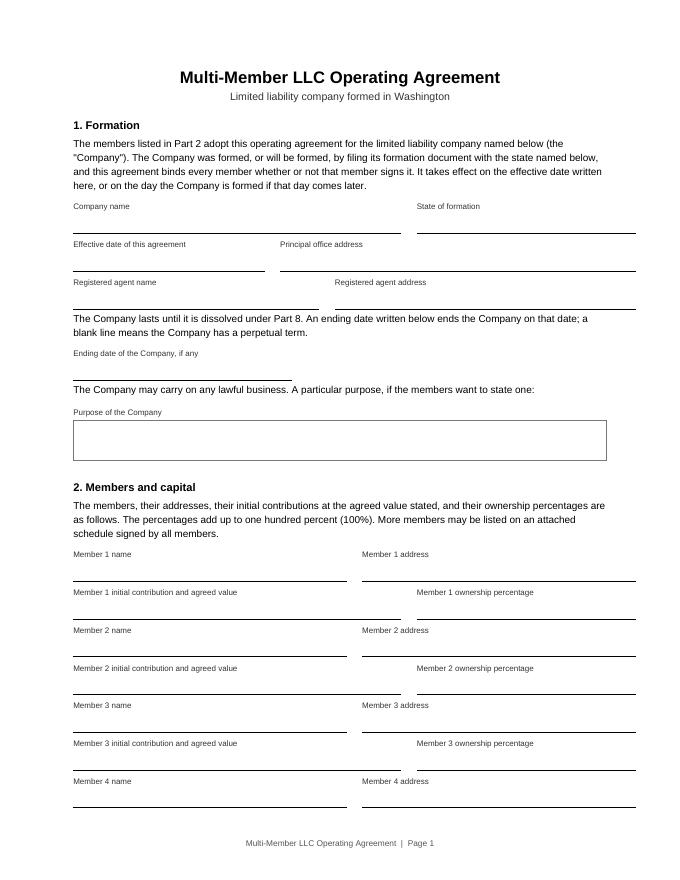
Part 5 of the document replaces the head count with ownership percentages; Part 3 shares profits, losses and distributions by those percentages instead of by agreed contribution value; Part 4 names six (6) acts that need the written consent of all members, a shorter list than the thirteen (13) in RCW 25.15.121(2), which RCW 25.15.121(3) lets the agreement cut down. The last row stays. Except as RCW 25.15.236(2) provides, a member of a member-managed company or a manager of a manager-managed company who consents to a distribution that breaks RCW 25.15.231, and in consenting fails to comply with the duty of care, is personally liable to the company for the amount that exceeds what could have been distributed without the violation (RCW 25.15.236(1)).
Forming the company
Execute the certificate of formation and deliver it to the Secretary of State, online or on the fillable form, with $180; file the initial report within 120 days; keep a copy of the agreement at the principal office.
One or more persons execute a certificate of formation and deliver it to the office of the Secretary of State for filing (RCW 25.15.071(1)). The certificate sets forth the company’s name, the name and address of its registered agent, the address of its principal office, the latest date of dissolution if the company is to have one, any other matters the members decide to include, and the name and address of each person executing it (RCW 25.15.071(1)(a) to (f)). The company is formed when the Secretary of State files the certificate, unless a delayed effective date is specified (RCW 25.15.071(2)). The fee for a public organic record is $180 under WAC 434-112-085(7)(a); the Secretary of State’s LLC and PLLC filing resource page, read 2026-11-02, lists the certificate of formation at $180 and the annual report at $70.
Each domestic limited liability company delivers initial and annual reports to the Secretary of State under RCW 23.95.255 (RCW 25.15.106). The initial report is due within 120 days after the certificate became effective (RCW 23.95.255(1)); it costs nothing when filed with the certificate and $10 when deferred (WAC 434-112-085(7)(n), (o)). The annual report updates the company’s registered agent, principal office, governors and business description (RCW 23.95.255(2)) and is delivered on a date the Secretary of State determines (RCW 23.95.255(4)); the Secretary’s filing page puts that date at the last day of the month in which the company was first formed. The fee is $70 (WAC 434-112-085(7)(p)). The schedule also lists a $25 delinquent fee and, for reinstatement from administrative dissolution, $140 plus all delinquent annual report fees (WAC 434-112-085(7)(r), (s)); the Secretary’s notice warns that a company that fails to file or pay will be administratively dissolved (RCW 23.95.255(7)), and administrative dissolution under RCW 23.95.610 dissolves the company unless the Secretary reinstates it (RCW 25.15.265(6)).
The agreement itself is kept, not filed; the Secretary of State’s filing page says an operating agreement “is not recorded by the Secretary of State”. RCW 25.15.136(1) requires a company to keep at its principal office a copy of its certificate of formation and amendments; “a copy of any limited liability company agreement made in a record” and any amendments made in a record; unless it is contained in the certificate of formation, a statement in a record of each member’s contributions and their agreed values, the times or events of any additional contributions, any right to a return of contribution and the events that dissolve the company; its tax returns, financial statements and vote records for the three (3) most recent years; its three most recent annual reports; and its conversion, merger and dissolution filings. On ten (10) days’ demand made in a record, a member may inspect and copy those records during regular business hours at the principal office and “need not have any particular purpose for seeking the records” (RCW 25.15.136(2)). Part 6 of the document keeps the agreement, the certificate, the member list, the contribution record and six (6) years of returns at the principal office and lets a member inspect them with no purpose stated; the rest of that list is the company’s duty under the act whatever the agreement says (RCW 25.15.018(3)(g)).
Signing
Each member signs one of the four member blocks in Part 11; the manager signs the fifth when Part 4 marks the company manager-managed.
Every member in Part 2 signs. The agreement is the agreement “of the member or members” (RCW 25.15.006(8)). RCW 25.15.006(4) counts a record as executed when a person signs or adopts a tangible symbol, or attaches an electronic symbol, sound or process to it, with present intent to authenticate or adopt it. No notary or witness appears in RCW 25.15.006, 25.15.018, 25.15.071, 25.15.086 or 25.15.136, nor anywhere else in the chapter as read whole on 2026-11-02. The federal rule, 15 U.S.C. 7001(a)(2), bars denying a contract legal effect, validity or enforceability solely because it was formed with an electronic signature or electronic record, where the transaction is in or affects interstate or foreign commerce.
Federal tax
Treasury Regulation § 301.7701-3(b)(1)(i) sorts a domestic eligible entity of two (2) or more members into partnership status for federal tax unless an election says otherwise. That election is Form 8832; the S corporation election is Form 2553, and Part 6 of the document marks whichever applies. The partnership’s information return is Form 1065, and Form SS-4 is the application for the employer identification number.
Without an agreement
RCW 25.15.018(2) supplies the answer: where the agreement does not provide for a matter, “this chapter governs the matter”. A company with no agreement therefore decides by a majority of its members, admits no new member without all of them, pays distributions by agreed contribution value, and owes a member who withdraws nothing (RCW 25.15.131(2)). Limited liability does not hang on the agreement. Except as the chapter otherwise provides, RCW 25.15.126(1) makes the company’s debts solely the company’s and says no member or manager is personally obligated for them solely by reason of being or acting as a member or manager, though RCW 25.15.061 holds members liable to the extent shareholders of a Washington business corporation would be in analogous circumstances. A company with one owner uses the single-member version of the LLC operating agreement; the multi-member operating agreement takes the four-member document one part at a time.
Frequently asked questions
Does Washington require an LLC to have an operating agreement?
The chapter does not, and RCW 25.15.006(8) accepts an oral or implied one. However, RCW 25.15.136(1)(b) requires the company to keep at its principal office a copy of any agreement “made in a record” and its amendments, and the Secretary of State’s filing page says LLCs “must also create an operating agreement”, words the chapter itself does not use.
Can the members vote by ownership share instead of by head?
Yes. RCW 25.15.121(1) counts a majority of the members by default, but RCW 25.15.121(4) says that if the agreement so provides, voting by members “may be on a per capita, profit share, class, group, or any other basis”. Part 5 of the document chooses ownership percentage.
What happens if the only manager quits or dies?
Under RCW 25.15.181 the company becomes member-managed unless a majority of the members appoint one or more managers within ninety (90) days after the sole remaining manager dies, resigns or is removed, or one of the events in RCW 25.15.131(1)(e) to (h) occurs with regard to that manager. Part 4 of the document lets members holding more than fifty percent (50%) appoint a replacement.