

State Laws
West Virginia’s act is chapter 31B of the Code, the “Uniform Limited Liability Company Act” (31B-12-1202), in force since July 1, 1996 (31B-12-1204). Section 31B-1-103(a) lets all the members enter into an operating agreement to regulate the affairs of the company and govern relations among the members, managers and company, and adds the rule that gives every default its opener: “To the extent the operating agreement does not otherwise provide, this chapter governs”. The articles may not vary the nonwaivable provisions of 31B-1-103(b); as to all other matters, a conflict between the two documents is settled by who is asking: inside the company, among managers, members and transferees, the agreement wins; for an outsider who reasonably relied on the articles to the outsider’s detriment, the articles win (31B-2-203(c)).
The limits are seven (7), set out in 31B-1-103(b). The agreement may not unreasonably restrict a right to information or access to records under 31B-4-408; may not eliminate the duty of loyalty, though it may, if not manifestly unreasonable, identify specific types or categories of activities that do not violate it, and may specify the number or percentage of members or disinterested managers that may authorize or ratify, after full disclosure of all material facts, a specific act that would otherwise violate it; may not unreasonably reduce the duty of care; may not eliminate the obligation of good faith and fair dealing, though it may determine the standards by which its performance is measured if they are not manifestly unreasonable; may not vary the right to expel a member by judicial determination under 31B-6-601(6); may not vary the requirement to wind up in the cases of 31B-8-801(b)(4) and (5); and may not restrict the rights of a person other than a manager, member and transferee. The duty of care itself is limited to refraining from grossly negligent or reckless conduct, intentional misconduct or a knowing violation of law (31B-4-409(c)), a standard that binds the managers of a manager-managed company while a member who is not a manager owes no duties solely by reason of being a member (31B-4-409(h)).
The defaults the document replaces
Every row below yields to the operating agreement under 31B-1-103(a) except where the cell names a 31B-1-103(b) item.
| Rule | West Virginia default | Section |
|---|---|---|
| Management | A company is manager-managed only if its articles of organization so designate it, and the articles must say whether it is manager-managed and name each initial manager; otherwise it is member-managed | 31B-1-101(14), (15), 31B-2-203(a)(6) |
| Weight of a vote and ordinary decisions | Unless the agreement provides otherwise: each member has equal rights in managing the business and any matter may be decided by a majority of the members, save the matters of 31B-4-404(c) and the continuation vote of 31B-8-801(b)(3)(i); in a manager-managed company each manager has equal rights and the manager, or a majority of several, decides any matter exclusively, with the same two exceptions | 31B-4-404(a), (b)(1), (2) |
| Matters that take every member | Unless the agreement provides otherwise, twelve (12): amending the agreement; ratifying an act that would breach the duty of loyalty; amending the articles; compromising a contribution obligation; compromising, as among members, an obligation to make a contribution or to return money or property paid or distributed in violation of the chapter; making an interim distribution or redeeming an interest; admitting a new member; using company property to redeem an interest under a charging order; consenting to dissolve; waiving the winding up; consenting to a merger; and selling, leasing, exchanging or disposing of all or substantially all of the property | 31B-4-404(c) |
| Choosing or removing a manager | Unless the agreement provides otherwise, a manager is designated, appointed, elected, removed or replaced by a vote, approval or consent of a majority of the members and holds office until a successor is elected and qualified, unless the manager sooner resigns or is removed; a manager need not be a member | 31B-4-404(b)(3), 31B-1-101(13) |
| Meetings and proxies | Unless the agreement provides otherwise, an action that needs the consent of members or managers may be taken without a meeting, and a member or manager may appoint a proxy by signing an appointment instrument, personally or by an attorney-in-fact | 31B-4-404(d), (e) |
| Distributions before dissolution | Unless the agreement provides otherwise: in equal shares; made only when all members consent to an interim distribution (31B-4-404(c)(6)); no member has a right to receive, or may be required to accept, a distribution in kind; a member entitled to a distribution has a creditor’s remedies for it | 31B-4-405, 31B-4-404(c)(6) |
| Transfer of an interest | A distributional interest is personal property and may be transferred in whole or in part; the transfer gives the transferee only the distributions the transferor would have received, and the transferee becomes a member only if the transferor was authorized by the agreement to give that right or all other members consent; a transferee who is not a member cannot take part in management, demand information or inspect records, but receives the distributions, the net amount on winding up and a statement of account from the last one all members agreed to; a transferee’s rights are the agreement’s to set, since 31B-1-103(b)(7) protects only persons other than a manager, member and transferee | 31B-5-501(b), 31B-5-502, 31B-5-503(a), (d), (e) |
| Dissociation and the buyout | Unless the agreement provides otherwise, a member may dissociate at any time by express will, rightfully or wrongfully, effective on notice or a later date the member names; a wrongful dissociation costs damages, which are offset against the price; if the company does not dissolve, an at-will company must cause the member’s distributional interest to be purchased at its fair value as of the dissociation date, with a purchase offer and a statement of assets and liabilities within thirty (30) days, and a term company must do so when its term expires; a price and terms fixed or determined by the agreement govern unless the purchaser defaults; without an agreed purchase within one hundred twenty (120) days the member may sue to enforce it within another one hundred twenty (120) days; from dissociation the member is treated the same as a transferee | 31B-6-601(1), 31B-6-602(a), (c), 31B-6-603(a), (b)(1), 31B-7-701(a) to (d), (f) |
| A member’s death | Death dissociates an individual member, as does the appointment of a guardian or general conservator or a judicial finding of incapacity; the company furnishes information to the legal representative of a deceased member or a member under legal disability, a right 31B-1-103(b)(1) protects against unreasonable restriction | 31B-6-601(8), 31B-4-408(b) |
| Dissolution events | An event specified in the agreement; the consent of the number or percentage of members the agreement specifies; the dissociation of a member who is also a manager or, if there is none, of a member of an at-will company, or of a member of a term company only for a reason in 31B-6-601(7) to (11) before the term ends, unless within ninety (90) days the remaining members entitled to a majority of the distributions on a dissolution on the date of dissociation and the remaining members entitled to a majority of the future distributions agree to continue, or the agreement states a right to continue; an event that makes the business unlawful, curable within ninety (90) days; a judicial decree on five (5) grounds, among them the company’s failure to buy the petitioner’s interest under 31B-7-701; or a transferee’s application; the agreement may not vary the winding up that follows the unlawful-business and judicial grounds (31B-1-103(b)(6)) | 31B-8-801(b) |
| Winding up order | Unless the agreement provides otherwise, the assets first discharge the company’s obligations to creditors, members who are creditors included; the surplus is paid in money, each member receiving back the contributions not previously returned and then an equal share of the remainder | 31B-8-806 |
| Records and inspection | Subject to 31B-1-103(b)(1): the company gives members and their agents and attorneys access to its records, if any, at the principal office or another reasonable location the agreement specifies, to inspect and copy during ordinary business hours, with a reasonable copying charge; former members get access for proper purposes to the records of their period of membership; the company furnishes without demand the information a member reasonably needs to exercise the member’s rights and perform the member’s duties, and on demand other information unless the demand is unreasonable or improper; a member may demand at the company’s expense a copy of any written operating agreement | 31B-4-408 |
Part 5 of the document weighs votes by ownership percentage where 31B-4-404(a)(2) counts members, Part 3 shares profits, losses and every distribution by those percentages and lets the members or the manager decide when to pay one where 31B-4-405(a) and 31B-4-404(c)(6) would pay equal shares on the consent of everyone, and Part 4 sets its own list of acts that take every member in place of the twelve (12) matters of 31B-4-404(c); 31B-1-103(a) hands all of that to the agreement, and 31B-1-103(b) protects none of it. The ceiling of 31B-4-406(a) stays in Part 3 (the document creates no preferential rights, so its second test asks whether liabilities would exceed assets), and a member or manager who votes for a distribution over it without performing the 31B-4-409 duties is personally liable for the excess in a proceeding begun within two (2) years after the distribution (31B-4-407(a), (d)).
Forming the company
Deliver the articles of organization to the Secretary of State with the $100 fee (31B-2-202(a)); keep the operating agreement at the principal office.
One or more persons organize the company by delivering articles of organization to the Secretary of State with the fee set by 59-1-2, and the company exists when the articles are filed unless they name a later date, no more than ninety (90) days out (31B-2-202(a), (b), 31B-2-206(d)). The articles carry nine (9) items under 31B-2-203(a), among them the name, which under 31B-1-105(a) must contain “limited liability company”, “limited company” or the abbreviation L.L.C., LLC, L.C. or LC, the offices and agent, whether the company is a term company, whether it is manager-managed and who the initial managers are, and an e-mail address for filing reminders. Except as the chapter provides otherwise, a filed record is signed in the company’s name by a manager of a manager-managed company, a member of a member-managed company, the person organizing a company not yet formed or a court-appointed fiduciary, with the signer’s name and capacity beside the signature, and an attorney-in-fact may sign for any of them (31B-2-205(a) to (c)). An application reserves a name for one hundred twenty (120) days, with one (1) renewal of the same length allowed (31B-1-106(a)).
The fees sit in chapter 59. Section 59-1-2a charges every domestic limited liability company an annual report fee of $25 after July 1, 2026, or a biennial report fee of $50 for a company in good standing that has elected biennial reporting after five consecutive timely annual reports (59-1-2a(c), (d)(3)), and 59-1-2(a) prices the articles of organization at $100, an amendment of the articles at $25, articles of termination at $25, reinstatement at $25 and a name reservation at $15 for each one hundred twenty (120) days; a veteran-owned or active-duty-member business commenced on or after the dates in 59-1-2(j) pays no formation fee. The Secretary of State’s annual reports page, read 2026-11-05, states the $25 fee and the January 1 to June 30 window and encourages filers to use the West Virginia One Stop Business Portal.
The first annual report is delivered between January 1 and July 1 of the year after the calendar year of organization, then between the same dates each year (31B-2-211(c)), and 59-1-2a(e) fixes the last moment at 11:59 PM on June 30. Missing the deadline costs an administrative late fee of $50 for an annual delinquency and $100 for a biennial one (59-1-2a(h)(1)(A)), and a report still not delivered sixty (60) days after it is due is a ground for administrative dissolution, after notice by certified mail and sixty (60) more days to cure (31B-8-809(a)(2), 31B-8-810(a), (b)).
The operating agreement is not filed. The articles may repeat provisions an agreement could carry (31B-2-203(b)(1)), but nothing in 31B-2-202, 31B-2-203 or 31B-2-211 sends the agreement itself to the Secretary of State, and 31B-1-103(a) does not even ask for a writing. Its home is the principal office or another reasonable location the agreement names, where 31B-4-408(a) gives members access to the company’s records. Part 6 of the document chooses the principal office for that purpose and lists what sits there: the agreement with its amendments, the articles, the member list, the record of contributions, tax returns for six (6) years and financial statements for three (3).
Signing
Each member in Part 2 signs one of the four member blocks in Part 11; the manager signs the fifth if Part 4 marks the company manager-managed.
The document has every member sign. The chapter does not require it: 31B-1-103(a) lets all the members enter into an operating agreement “which need not be in writing”, and 31B-1-101(20) counts “any manual, facsimile, conformed or electronic signature” as a signature. No notary, acknowledgment or witness is named for the operating agreement in 31B-1-101, 31B-1-103, 31B-2-202, 31B-2-203 or 31B-2-205, nor in any other section of articles 1 to 14 of chapter 31B as read on 2026-11-05; “notary” and “witness” do not appear in those articles, and the one acknowledgment is the confirmatory deed a merging company records for its real estate under 31B-9-904(f). Electronic signing rests on federal law: under 15 U.S.C. 7001(a)(2), the fact that a contract in or affecting interstate or foreign commerce was formed with an electronic signature or electronic record is no ground, by itself, to deny the contract legal effect, validity or enforceability.
Federal tax
Except for an entity in existence before the regulation took effect (paragraph (b)(3)), Treasury Regulation § 301.7701-3(b)(1) treats a domestic eligible entity with two (2) or more members as a partnership and one with a single owner as disregarded, unless the entity elects otherwise. Corporate treatment takes Form 8832, the entity classification election; S corporation status takes the section 1362(a) election on Form 2553; Part 6 of the document records whether the Company has elected corporation treatment. Form SS-4 gets the employer identification number.
Without an agreement
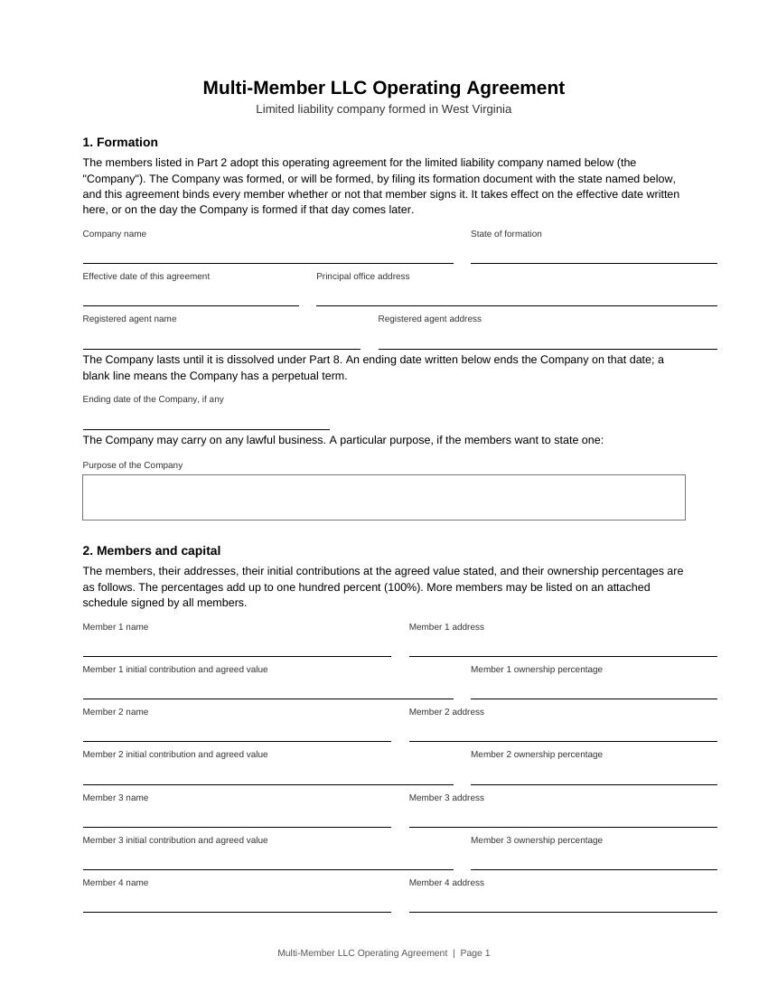
Members who adopt nothing run the company on the chapter’s defaults (31B-1-103(a)). The shield stands unless 31B-3-303(c) applies: the debts of the company are solely its own, and a member or manager is not personally liable for them solely by reason of being or acting as one, except where the articles so provide and the member consented in writing, the member guaranteed the debt in writing, the law imposes a tax liability on the member, or the member commits actual or constructive fraud that causes injury (31B-3-303(a), (c)). A company with one (1) owner starts from the single-member operating agreement in the LLC operating agreement section; the multi-member operating agreement describes the eleven (11) parts this West Virginia version carries.
Frequently asked questions
Why does the document say a departing member gets no buyout?
Because 31B-6-603(a)(1) and 31B-7-701(a) would otherwise make an at-will company that continues after the member leaves buy the member’s distributional interest at fair value, with an offer due within thirty (30) days. Those sections yield to the agreement under 31B-1-103(a), so Part 8 of the document provides otherwise: the remaining members hold a one hundred eighty (180) day option to buy at fair value and a holder who is not bought out receives a transferee’s distributions but no payment for the dissociation.
Must the articles say the company is manager-managed?
Yes, if the company is to be manager-managed. A manager-managed company is one “so designated in its articles of organization” (31B-1-101(14)), and 31B-2-203(a)(6) makes the articles state whether the company is to be manager-managed and, if so, name each initial manager. Part 4 of the document says its box matches the articles; a later change takes articles of amendment under 31B-2-204(a), filed for $25.
What happens when the annual report is late?
The Secretary of State assesses an administrative late fee of $50 for an annual delinquency (59-1-2a(h)(1)(A)), and once the report is sixty (60) days overdue the office may begin administrative dissolution, giving notice by certified mail and sixty (60) days to cure (31B-8-809(a)(2), 31B-8-810). Reinstatement after an administrative dissolution stays open for two (2) years from its effective date (31B-8-809(b)).