

Things to know
|
How to Write
Step 1 – Download
The form can be completed online, or by printing and completing the document by-hand. Download: PDF (.pdf), Word (.docx), or RTF (.rtf).
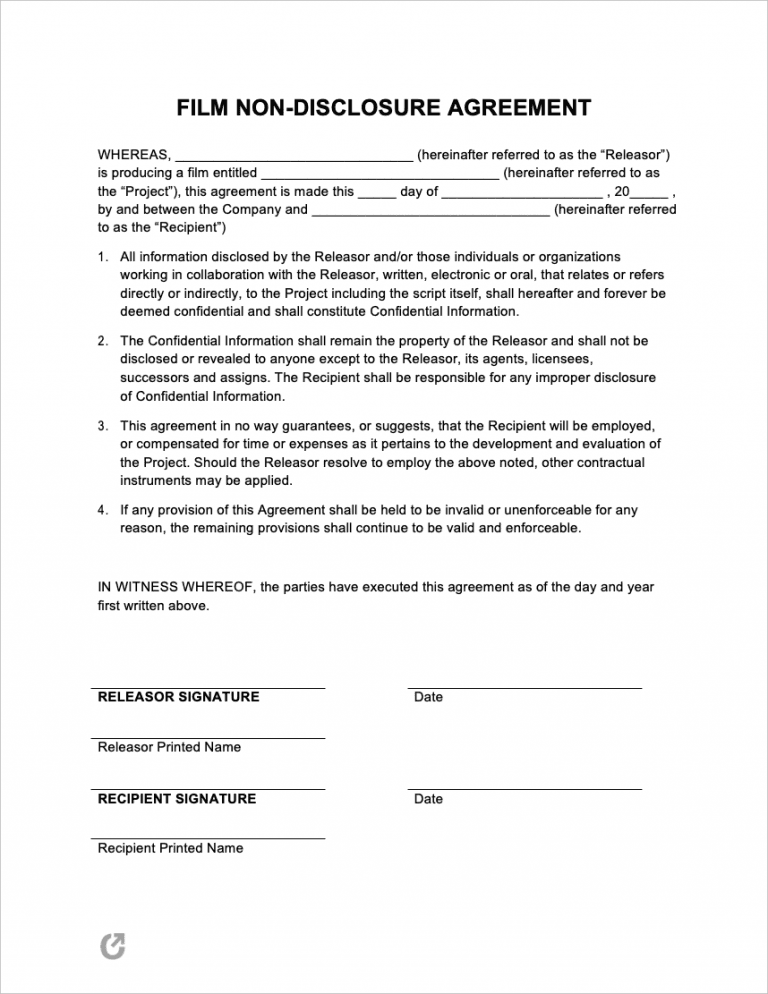
Step 2 – Establish the Parties
Once the form is ready to be filled in, the production company (the “Releasor”) will need to enter the following:
- Name of the releasing entity (the production company);
- Name of the production / film;
- Date the parties are entering into the agreement (day, month, and year); and
- The name of the employee/cast member on the receiving end of the information (known as the “Recipient”).
Step 3 – Signing
Once the Recipient and Releasor have read through the contract in-full, they will need to 1) sign their names, 2) write the date they signed, and 3) write their printed names. Once all signatures have been recorded, copies of the completed contract should be given to all involved parties.
What a production can hold as a trade secret
A script in development, a casting list, a shooting schedule and a release date are business information, and the Defend Trade Secrets Act covers “all forms and types of financial, business, scientific, technical, economic, or engineering information” that meets two (2) tests (18 U.S.C. 1839(3)). The definition’s own list of forms includes patterns, plans, compilations, methods, techniques, processes, procedures and programs, whether tangible or intangible, and however stored. The two (2) tests are that the owner has taken reasonable measures to keep the information secret, and that it derives independent economic value, actual or potential, from not being generally known to, and not readily ascertainable through proper means by, another person who could obtain economic value from its disclosure or use.
A signed confidentiality agreement is one step an owner can point to for the reasonable measures the first test asks for. It also creates the duty that turns a later leak into misappropriation: disclosure or use of the secret without express or implied consent by a person who, at the time, knew or had reason to know that the knowledge was acquired under circumstances giving rise to a duty to maintain its secrecy or limit its use (1839(5)(B)(ii)(II)).
The screenplay’s copyright
Copyright is a different right with a different source. Protection subsists in original works of authorship fixed in any tangible medium of expression, and the list of works of authorship includes literary works at (1) and motion pictures and other audiovisual works at (6) (17 U.S.C. 102(a)). The words of a written screenplay fit the definition of literary works: works, other than audiovisual works, expressed in words, numbers or other verbal or numerical symbols, regardless of the nature of the material objects, such as manuscripts, film, tapes or disks, in which they are embodied (17 U.S.C. 101). The finished film is a motion picture: an audiovisual work consisting of a series of related images which, when shown in succession, impart an impression of motion, together with accompanying sounds, if any (same section).
However, copyright never extends to any idea, procedure, process, system, method of operation, concept, principle or discovery, regardless of the form in which it is described or embodied in the work (102(b)). The premise of the film is an idea, which 102(b) leaves out, so copyright on its own does not bind a crew member who describes it. That is the gap the non-disclosure agreement closes: the contract covers what copyright leaves out.
Who owns what the cast and crew write
Copyright in a work vests initially in its author (17 U.S.C. 201(a)). For a work made for hire, the employer or other person for whom the work was prepared is considered the author and, unless the parties have expressly agreed otherwise in a written instrument signed by them, owns all of the rights comprised in the copyright (201(b)). Section 101 gives the term two (2) branches. A work prepared by an employee within the scope of their employment is one. The other is a work specially ordered or commissioned for use in one of nine (9) listed ways, and “as a part of a motion picture or other audiovisual work” is on that list, if the parties expressly agree in a written instrument signed by them that the work shall be considered a work made for hire.
Therefore a confidentiality promise alone does not move the copyright. A production that commissions a rewrite, a storyboard or a score from someone outside its payroll needs a signed writing that calls the contribution a work made for hire (17 U.S.C. 101), or a transfer of the copyright, which is not valid unless in a writing signed by the owner of the rights conveyed or the owner’s authorized agent (17 U.S.C. 204(a)); the non-disclosure agreement can carry that clause.
Deadlines and penalties
A civil action for misappropriation of a trade secret may not be commenced later than three (3) years after the misappropriation was discovered, or should have been discovered with reasonable diligence (18 U.S.C. 1836(d)), provided the secret is tied to a product or service used, or meant to be used, in interstate or foreign commerce (1836(b)(1)).
For the copyright, except for an action for a violation of the author’s rights under section 106A(a), no civil action for infringement of a United States work shall be instituted until preregistration or registration of the copyright claim has been made (17 U.S.C. 411(a)). If the deposit, application and fee were delivered in proper form and registration was refused, the applicant may still sue after serving notice and a copy of the complaint on the Register of Copyrights. An infringer is liable for either the owner’s actual damages plus the infringer’s profits attributable to the infringement, or statutory damages (17 U.S.C. 504(a), (b)). Statutory damages are elected at any time before final judgment, for all infringements of any one work, at not less than $750 or more than $30,000 as the court considers just; where the owner proves the infringement was willful, the court may raise the award to not more than $150,000, and where the infringer proves they were not aware and had no reason to believe their acts were infringing, the court may lower it to not less than $200 (504(c)(1), (2)). However, no award of statutory damages or attorney’s fees is made for infringement of an unpublished work that began before its registration, or for infringement that began after first publication and before registration unless the registration is made within three (3) months after first publication; a work preregistered under section 408(f), an action under section 106A(a) and a broadcast action under section 411(c) are outside that rule or have a timing rule of their own (17 U.S.C. 412).
Signing requirements
The releasor and the recipient both sign. Two (2) points come from the sections read. A work-made-for-hire clause for a commissioned contribution is effective only in a written instrument signed by the parties (17 U.S.C. 101), and the parties can agree that someone other than the employer or commissioning person owns the rights only in a written instrument signed by them (201(b)). For a transaction in or affecting interstate or foreign commerce, the E-SIGN Act provides that a signature, contract or other record relating to it may not be denied legal effect, validity or enforceability solely because it is in electronic form (15 U.S.C. 7001(a)(1)). No section read names a witness or a notary for either document.
The parts of a film NDA
| Element | What it does | Source |
|---|---|---|
| Releasor and recipient | Names the production company and the cast or crew member | 18 U.S.C. 1839(4) |
| The production | Identifies the film whose script, cast and plans are the secret | 18 U.S.C. 1839(3) |
| Confidential information | Lists the script, casting, schedule and release plans as the information kept secret | 18 U.S.C. 1839(3) |
| Duty of secrecy | Creates the circumstances that make a later disclosure misappropriation | 18 U.S.C. 1839(5)(B)(ii)(II) |
| Work made for hire | For a commissioned contribution to the film, the signed written agreement that the production is its author | 17 U.S.C. 101, 201(b) |
| Term | No section read fixes one; a misappropriation suit runs three (3) years from discovery | 18 U.S.C. 1836(d) |
Federal law also tells an employer to put a whistleblower immunity notice into an agreement with an employee, including a contractor or consultant (18 U.S.C. 1833(b)(3), (4)); the employee non-disclosure agreement page covers it, and the other forms are collected under non-disclosure agreements.
Frequently asked questions
Is the plot of a film protected by copyright?
Not as a bare idea. Copyright does not extend to any idea, concept, system or method of operation, regardless of how it is described in the work (17 U.S.C. 102(b)); the written script is protected, the idea behind it is not. The non-disclosure agreement is what binds a recipient over the idea.
Who owns a script a hired writer delivers?
If the writer is an employee writing within the scope of employment, or the script was specially commissioned as part of a motion picture and both sides signed a written instrument calling it a work made for hire, the production is the author and, unless the parties expressly agreed otherwise in a signed written instrument, owns all the rights in the copyright (17 U.S.C. 101, 201(b)). For a writer outside the payroll with no such writing, copyright vests initially in the writer as author (201(a)), and a transfer to the production needs a signed writing (17 U.S.C. 204(a)).
Can the production sue over a copied script before registering it?
Not for infringement of a United States work; preregistration or registration comes first (17 U.S.C. 411(a)). A claim under the non-disclosure agreement has no registration step, and 18 U.S.C. 1836(b) names none for a trade secret claim.