

Things to know
|
How to Write
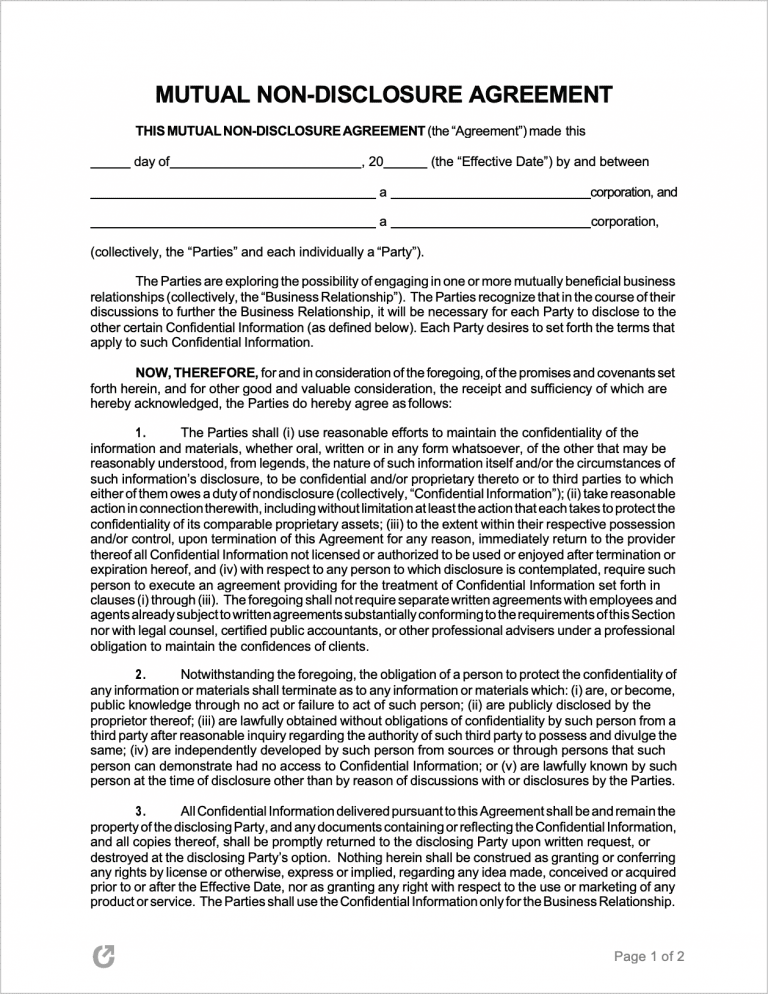
Prior to heading to the first step, save the agreement in one of the following three (3) formats: Adobe PDF, Microsoft Word (.docx), or Rich Text Format (.rtf).
Step 1 – Read through the agreement
Taking the time to read through the contract is pivotal. Both parties should know exactly what they’re agreeing to, to ensure they’re not setting themselves up for a confrontation or dispute later on. So long there are no questions surrounding the agreement, the parties can continue to the next step.
Step 2 – Party names + addresses
Enter the date in which the contract is being entered into (day, month, and year), followed by the names (and type of corporation) of both parties.
Step 3 – Signatures
Both parties will need to enter the following information to make the agreement go into effect:
- Their signatures (handwritten or electronic);
- The company names;
- The printed names of the individuals signing;
- The title or roles (in their company) of those signing the form.
Two owners, two recipients
The Defend Trade Secrets Act defines the owner of a trade secret as the person or entity in whom rightful legal or equitable title to it, or a license in it, is reposed (18 U.S.C. 1839(4)). In a mutual agreement each company is the owner of what it hands over and the recipient of what it takes in. Information is a trade secret when its owner has taken reasonable measures to keep it secret and it derives independent economic value from not being generally known to, or readily ascertainable through proper means by, someone who could profit from it (1839(3)).
Acquiring a secret of another while knowing, or having reason to know, that it was acquired by improper means is misappropriation; so is disclosing or using it without express or implied consent when the recipient knew, or had reason to know, that it came under circumstances giving rise to a duty to maintain its secrecy or limit its use (1839(5)). Reverse engineering, independent derivation and any other lawful means of acquisition are not improper means (1839(6)(B)).
Suing under the Defend Trade Secrets Act
An owner of a trade secret that is misappropriated may bring a civil action when the secret relates to a product or service used in, or intended for use in, interstate or foreign commerce (18 U.S.C. 1836(b)(1)). The United States district courts hear it (1836(c)). The deadline is three (3) years from the date the misappropriation was discovered, or by reasonable diligence should have been (1836(d)).
The court may grant an injunction against actual or threatened misappropriation, including an order requiring affirmative actions to protect the secret, but the injunction cannot prevent a person from entering an employment relationship, and conditions placed on that employment must rest on evidence of threatened misappropriation, not merely on what the person knows (1836(b)(3)(A)(i)(I)). Damages cover actual loss plus any unjust enrichment the loss figure misses; in their place the court may impose a reasonable royalty for the unauthorized disclosure or use (1836(b)(3)(B)). Where the misappropriation was willful and malicious, exemplary damages of up to two (2) times the damages may be added (1836(b)(3)(C)). The court may award reasonable attorney’s fees to the prevailing party where a claim is made in bad faith, a motion to terminate an injunction is made or opposed in bad faith, or the secret was willfully and maliciously misappropriated (1836(b)(3)(D)).
The immunity notice in a mutual agreement
The notice rule in 18 U.S.C. 1833(b)(3) is written for an employer’s contract with an employee that governs the use of a trade secret or other confidential information, and “employee” there includes any individual performing work as a contractor or consultant for the employer (1833(b)(4)). A mutual NDA between two (2) companies is not that contract. One signed by a company and an individual consultant who performs work for it is, whenever it governs the use of a trade secret or other confidential information.
The notice states the immunity: an individual is not criminally or civilly liable under federal or state trade secret law for disclosing a trade secret in confidence to a government official or an attorney solely to report or investigate a suspected violation of law, or in a filing made under seal (1833(b)(1)). A cross-reference to a policy document setting out the reporting policy counts (1833(b)(3)(B)). An employer that skips the notice may not be awarded exemplary damages or attorney fees under 1836(b)(3)(C) or (D) against that individual (1833(b)(3)(C)).
Signing a mutual agreement
Both parties sign. The E-SIGN Act provides that, for a transaction in or affecting interstate or foreign commerce, a signature or contract may not be denied legal effect, validity or enforceability solely because it is in electronic form (15 U.S.C. 7001(a)). The Act does not make any person agree to use or accept electronic records or electronic signatures, other than a governmental agency with respect to a record other than a contract to which it is a party (7001(b)(2)). The contracts and notices outside section 7001 (wills, state family law, most of the Uniform Commercial Code, court documents and certain notices) are listed in 15 U.S.C. 7003, and a confidentiality agreement is not among them.
| Formality | What the federal sections say | Status |
|---|---|---|
| Notary | Not named in 18 U.S.C. 1836 or 1839; 7001(g) covers only electronic notarization where another law requires one | Not required by the sections read |
| Witness | Not named in any section read | Not required by the sections read |
| Written agreement | No section read requires one; 1839(5) looks to the circumstances of the disclosure | Not required by the sections read |
| Immunity notice | When one signer is an individual employee, contractor or consultant of the other and the agreement governs the use of a trade secret or other confidential information; without it the employer loses exemplary damages and attorney fees (1833(b)(3)(C)) | Required |
| Electronic signature | Not denied effect under 7001(a); either side may decline it (7001(b)(2)) | Allowed |
What neither side can agree to hide
The Speak Out Act makes a nondisclosure clause or nondisparagement clause agreed to before a dispute arises judicially unenforceable with respect to a sexual assault dispute or a sexual harassment dispute in which the conduct is alleged to violate federal, tribal or state law (42 U.S.C. 19403(a)). A nondisparagement clause is one that requires a party not to make a negative statement about another party relating to the contract, agreement, claim or case (42 U.S.C. 19402(2)). The chapter applies to claims filed on or after December 7, 2022 (42 U.S.C. 19404), and it does not prohibit an employer and an employee from protecting trade secrets or proprietary information (19403(d)).
The parts of a mutual NDA
| Element | What it does | Source |
|---|---|---|
| Date and parties | Names both companies, each as owner and recipient | 18 U.S.C. 1839(4) |
| Each party’s confidential information | Describes what each side is handing over, in any form | 18 U.S.C. 1839(3) |
| Purpose and permitted use | Sets the circumstances that give rise to a duty to limit the use of the secret | 18 U.S.C. 1839(5)(B)(ii)(II) |
| Term and survival | No section read fixes a length; suit within three (3) years of discovery | 18 U.S.C. 1836(d) |
| Return or destruction | Not set by any section read; a court may order affirmative actions to protect the secret | 18 U.S.C. 1836(b)(3)(A)(ii) |
| Governing law | The DTSA claim is heard in a United States district court | 18 U.S.C. 1836(c) |
A one-way disclosure uses the unilateral non-disclosure agreement instead.
Frequently asked questions
Does a mutual NDA have to be notarized?
Not under any of the federal sections read for this document; 7001(g) of the E-SIGN Act says only how a notarization that some other law requires can be done electronically.
Is reverse engineering the other party’s product a breach of the agreement?
Under 18 U.S.C. 1839(6)(B), reverse engineering is not an improper means, so acquiring a secret that way is not misappropriation by improper means; that section does not address a contract term that forbids it.
Does the three-year limit start over each time the secret is used?
No. A continuing misappropriation is a single claim, and the three (3) years run from when the misappropriation was discovered or should have been (18 U.S.C. 1836(d)).