

Things to know
|
Requirements
What the Property Code says a deed is
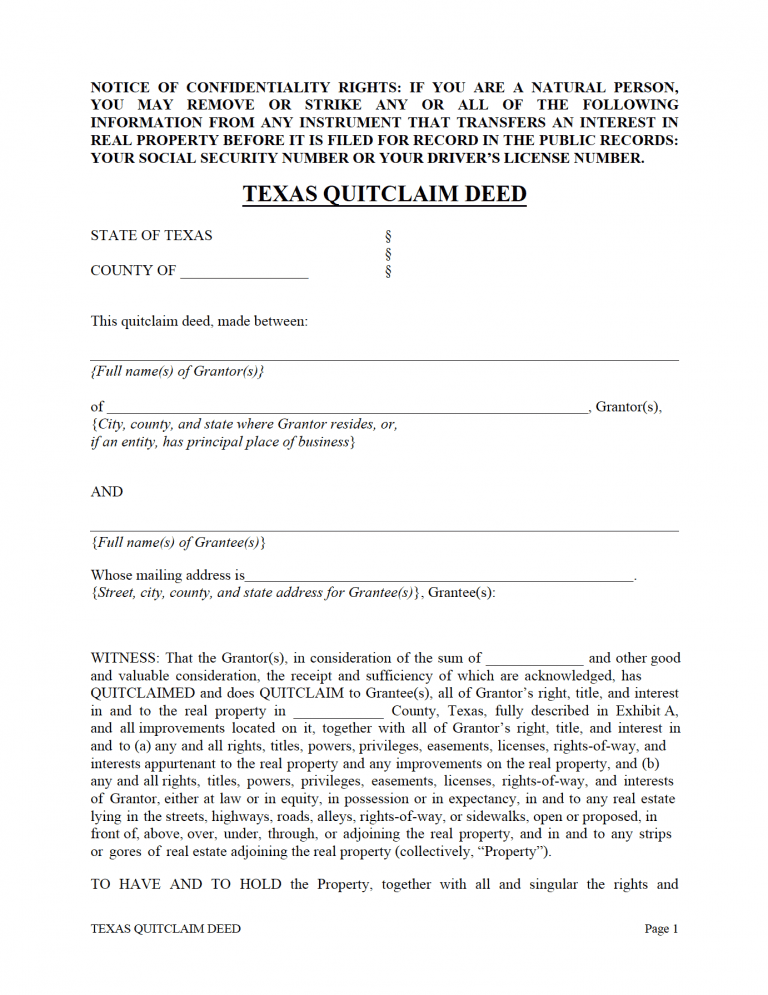
Under § 5.021 a conveyance of an estate of inheritance, a freehold or an estate for more than one (1) year in land must be in writing, subscribed and delivered by the conveyor or the conveyor’s agent authorized in writing. The deed form printed in § 5.022(a) conveys a fee simple estate with a covenant of general warranty: the grantor binds himself and his heirs to “warrant and forever defend” the premises against every person lawfully claiming them. A covenant of warranty is not required in a conveyance (§ 5.022(b)), and the parties may use any form not in contravention of law (§ 5.022(c)).
Acknowledgment before an officer
In person, or by the two-way audio and video of an online notarization (§ 121.006(c)).
Within Texas, a clerk of a district court, a judge or clerk of a county court, or a notary public may take the acknowledgment or proof, among the officers in Civil Practice and Remedies Code § 121.001(a). The grantor appears before the officer and states that he executed the deed for the purposes and consideration expressed in it; the officer makes a certificate, signs it and seals it with the seal of office (§ 121.004). To prove a deed signed before witnesses for recording, at least one (1) of the witnesses who signed it must appear before such an officer and swear that he saw the grantor sign it, or that the grantor acknowledged executing it in the witness’s presence, and that he signed at the grantor’s request (§ 121.009(a)).
For the acknowledgment or proof of a deed, including certificate and seal, a notary public or the notary’s employer may charge $10 for the first signature and $1 for each additional signature, no more (Government Code § 406.024(a)(5) and (b)); the secretary of state adjusts the amounts for inflation once every five (5) years (§ 406.024(c)).
The county clerk’s fees
Local Government Code § 118.011(a)(2) sets the real property records filing fee, in addition to any other specific fee provided by other statute (§ 118.013(d)).
| Charge | Amount | Section |
|---|---|---|
| First page | $5.00 | § 118.011(a)(2)(A) |
| Each additional page or part of a page with visible marks of any kind | $4.00 | § 118.011(a)(2)(B) |
| Records management and preservation fee, if the clerk sets it, paid at filing | Not more than $10 | § 118.011(b)(2), § 118.0216(b) |
| Records archive fee, if adopted in the county’s annual budget | Not more than $10 | § 118.011(f)(1), § 118.025 |
| Certified copy (certificate plus each page on paper) | $5.00 plus $1.00 a page | § 118.011(a)(3)(A), (B) |
A missing Grantee address does not affect the validity of the conveyance between the parties (Property Code § 11.003(b)); once the clerk takes the fee and accepts the deed for recording, the address requirement is conclusively presumed met (§ 11.003(c)). Whoever files in person shows photo identification, which the clerk copies or records at no charge (Local Government Code § 191.010(b)); the deed is not invalid solely because the clerk skipped that (§ 191.010(d)).
A deed that is never recorded
Under Property Code § 13.001(a), a conveyance of real property or an interest in it is void as to a creditor or a subsequent purchaser for consideration without notice unless the instrument has been acknowledged, sworn to, or proved and filed for record as required by law. It still binds a party to it, the party’s heirs, and a subsequent purchaser who does not pay for the land or who has notice of it (§ 13.001(b)). See the quit claim deed page for other states, including Oklahoma.
Frequently asked questions
Can the Grantor sign a Texas quit claim deed in another state?
Yes. Outside Texas but inside the United States or its territories, a clerk of a court of record having a seal, a commissioner of deeds appointed under Texas law, or a notary public may take the acknowledgment or proof (§ 121.001(b)). A notary’s missing seal there invalidates it only if that jurisdiction requires the seal (Property Code § 12.001(d)).
Does Texas charge a transfer tax when a deed is recorded?
Under article VIII, § 29(a) of the Texas Constitution, after January 1, 2016, no law may be enacted that imposes a transfer tax on a transaction that conveys fee simple title to real property. The section does not prohibit a general business tax measured by business activity, a tax on the production of minerals, a tax on the issuance of title insurance, or a change in the rate of a tax in existence on January 1, 2016 (§ 29(b)).
What identification does the person filing the deed show?
Section 191.010(a) of the Local Government Code lists a driver’s license, election identification certificate or personal identification card from any state or territory, a United States military identification card or citizenship certificate with the person’s photograph, a Permanent Resident Card, a municipal general identification card, a federally recognized tribal enrollment card or other tribal identification, a United States passport or a foreign passport recognized by the United States, or a Department of Public Safety license to carry a concealed handgun. Each, other than the citizenship certificate, may have expired no earlier than sixty (60) days before it is presented.