

Things to know
|
How to write in PDF and Word
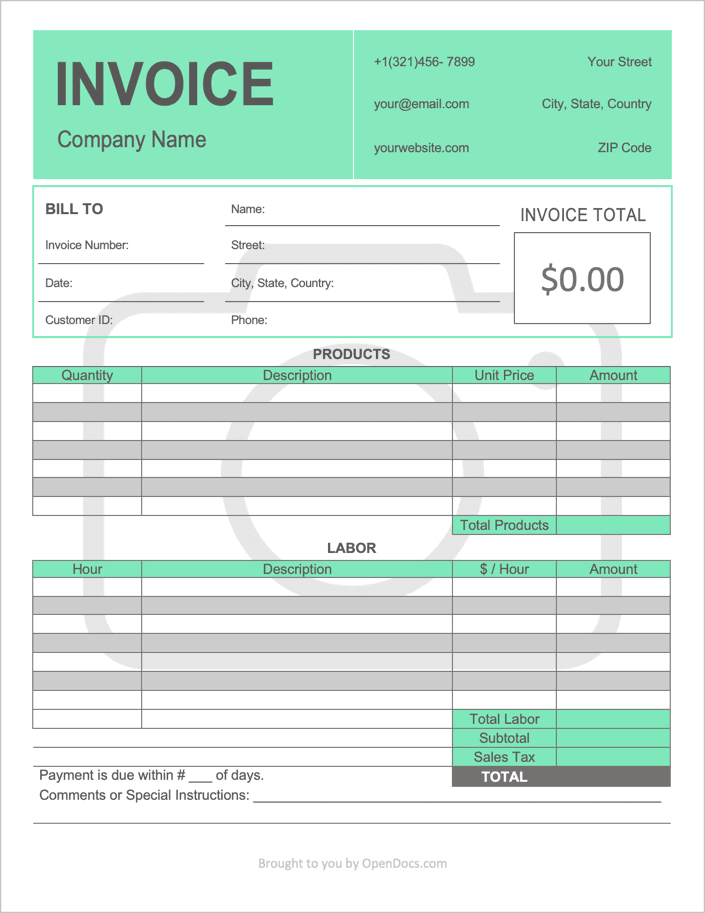
Step 1 – Download the Photography Invoice in Adobe PDF or Microsoft Word (.docx).
Step 2 – Enter the Company Name (or the name of the freelancer) followed by the Contact Information of the photographer or company.
Step 3 – Complete the Bill To section. The following information will need to be recorded:
- Invoice Number
- Date (the service(s) took place)
- Customer ID
- Client Name
- Address (Street, City, State, Country, and ZIP)
- Client’s Telephone Number
The ‘Invoice Total’ field will calculate automatically if using the PDF format. If using the Word template, enter the total invoice amount after calculating the amount in Step 6.
Step 4 – In the Products table, enter the items the client purchased or were expended during the service(s) performed. Tools or materials that can be used for more than one job should not be included here. Start by entering a brief Description of each type of product, then head to the far left of the table and enter the Number of products purchased. Then enter the Unit Price of a single product, and multiply this value by the number of products for each row. Sum the Amount column and enter the result into the Total Products field.
Step 5 – In the table directly below, enter the Services that were completed for the client. Much like the fourth (4th) step, multiply the number of Hours each service took to complete by the Hourly Rate set by the photographer, sum the resulting Amounts, and enter the result into the Total Labor cell.
Step 6 – Calculate the final invoice amount by adding on any Sales Tax to the Subtotal field, which is the sum of the Total Products and Total Labor fields. The TOTAL amount will then be displayed. Enter any Comments for the client, such as accepted payments or a more detailed product description. Then, complete the form by entering the number of Days the customer has to pay for the products and services. It is recommended that the photographer withholds the photos until the invoice is paid in full.
Session fee, license and delivery date
Five (5) lines belong to the trade.
|
Washington’s photography tax guide says the invoice, contract or other instrument of sale must clearly state the specific intangible rights granted when a photograph is licensed, and that a line item reading “licensing” or “rights of usage” is not by itself determinative if the exact rights are not described; its example grants a business the use of images for four (4) years in promotional material distributed inside the United States, with limited website use. The photographic negative is one of the objects named in the House report printed under 17 U.S.C. § 202, which provides that ownership of a copyright is distinct from ownership of the object and that transferring the object does not of itself convey any rights in the work. A client who is handed prints or a drive of files therefore receives no rights in the copyright from that transfer alone; the House report says a specific written conveyance is needed for the copyright to pass with them.
Sales tax on a photography invoice in three states
| State | Rule from the revenue agency |
|---|---|
| Washington | A portrait or event photographer who sells photographs to the customer generally collects sales tax on all charges when the customer takes delivery in Washington, among them sitting fees, travel reimbursements and touch-up fees, whether the pictures are finished prints, a download or a CD, and a digital photograph transferred electronically is a digital good taxed the same way. Licensing a photograph for further commercial display while keeping ownership of it is reported under the Royalties B&O classification with no sales tax, whatever the delivery method, and a sitting fee tied to such a license follows the same rule. A business customer that will use an electronically delivered photo solely for business purposes and gives the Digital Products and Remote Access Software Exemption Certificate is not charged sales tax; a government agency does not count as a business for that exemption. |
| Minnesota | The Department of Revenue taxes by delivery method: printed photos, proofs, negatives, CDs and flash drives are taxable, images sent by email or downloaded from a website are not, and the invoice must clearly show the items were delivered electronically. A taxable sale is taxed on the entire amount billed, including separately stated consultation, copyright or licensing fees, delivery, editing, models, props, sitting or session fees, stylists, travel expenses and wardrobe when they are required as part of the sale; a sitting fee that leads to no sale of tangible photos or proofs is not a taxable sale. One price for both tangible and electronic delivery is taxable unless the taxable part is 10 percent or less of the price, and the rate is the one in force where the product is delivered. |
| California | The CDTFA guide generally applies tax to photographs sold in tangible form (prints, slides, disks, flash drives) and then to the entire charge: the product, the labor to create it, and reproduction rights such as license fees or royalties for the customer’s private use. Overhead and project expenses on such a sale are taxable too, sitting fees, equipment rental, travel and models’ fees among them, while a sitting fee is not taxed if the customer buys no prints. Photographs transferred electronically with no tangible property are generally not subject to tax, together with the session charges and reproduction rights that go with them. Separately stated delivery by common carrier is not taxed up to the actual cost of the delivery, and the guide asks for terms such as “delivery”, “shipping” or “postage” on the invoice to identify it. |
The client’s records and Form 1099-NEC
For a business client the invoice is an expense document: Publication 583 wants such a document to show the amount paid and that the amount was for a business expense, and it lists invoices beside canceled checks, account statements and credit card sales slips. On the photographer’s side, Publication 334 says to use a proper invoicing system and keep a separate bank account for the business.
A business that pays a self-employed photographer $2,000 or more for services during 2026, product shots for a catalog for example, files Form 1099-NEC; the threshold applies to tax years beginning after 2025 and may be adjusted for inflation from 2027. A payment to a photography corporation is generally exempt, apart from the two (2) exceptions that page names, and a personal payment, such as a couple paying for their wedding album, is not reportable at all.
A shoot that ends in a film goes on the videographer invoice, a sale of prints as art on the artist invoice, and the other trades are in the invoice templates collection.
Frequently asked questions
Does a Washington photographer collect tax on a wedding delivered to Idaho?
No. The guide’s example has a Spokane photographer mail the prints and a CD to the couple’s Idaho home; no sales tax is collected on any part of the contract because the photos are delivered outside Washington, and the photographer takes the interstate and foreign sales deduction on the excise tax return.
Does a separate invoice for prints keep the session out of California tax?
No. In the CDTFA’s example a customer hires the photographer for a session and prints, and gets one invoice for $1,000 of digital images and another for $100 of prints; tax is due on the whole $1,100 because the prints were part of the hiring from the start.