

Things to know
|
What a dry cleaning invoice records
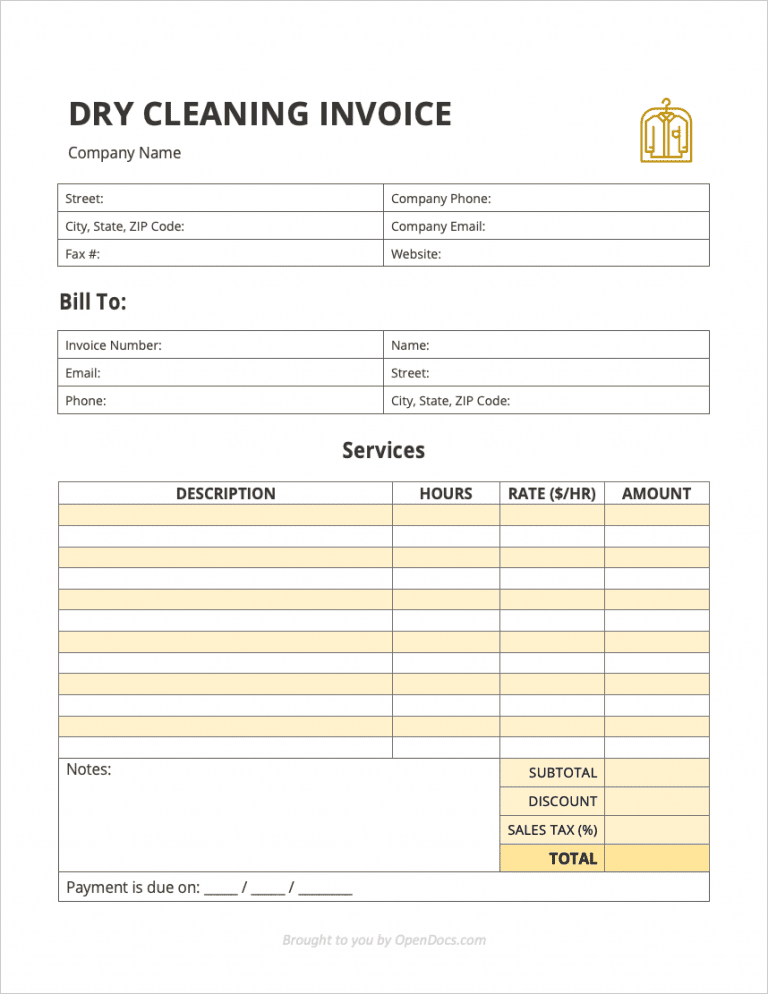
A cleaning ticket does two jobs. It is the customer’s receipt for the garments left behind, and it is the cleaner’s record of the condition each item arrived in. A short ticket that lists only a total leaves both sides with nothing to point to later.
|
A pickup and delivery fee goes on its own line; Ohio, for one, counts it as part of the taxable price (see the tax table below).
Care labels and the cleaner
The Care Labeling Rule is a Federal Trade Commission rule, and the FTC’s business guidance says it requires manufacturers and importers to attach care instructions to clothing and some piece goods. The FTC lists five elements of a washing instruction. The label must say whether the product is washed by hand or by machine, say “No bleach” or “Do not bleach” when every commercial bleach would harm it, and say whether the product is dried by machine or another method. It must give ironing information if the product needs repeated ironing, and it must warn against any care procedure that a consumer could reasonably use and that would harm the product.
Two points apply to a cleaner reading a label. A manufacturer needs a reasonable basis for every instruction, so the FTC says a “Dryclean Only” label requires proof that washing would harm the garment. Labels must be attached permanently and stay legible for the useful life of the product. Among the items outside the rule are shoes, gloves and hats, and among those that need no care instructions are garments custom-made of material that the customer provided.
On the ticket, a missing or unreadable label can be recorded as a condition note at intake.
Sales tax on dry cleaning
| State | How the state treats dry cleaning |
|---|---|
| Texas | Laundry, cleaning and garment services are taxable. The Comptroller’s examples include dry cleaning garments or rugs, garment alterations, mending and repair, and ironing or pressing garments. |
| Washington | Dry cleaning income is subject to Retailing business and occupation tax, and retail sales tax is collected on the total charge. The rate follows where the customer receives the cleaned items. |
| Ohio | Dry cleaning and laundry services are taxable, except coin-operated machines. Anything charged for pickup and delivery is part of the taxable price. |
| Minnesota | Laundry, dry cleaning and alterations services are on the Department of Revenue’s list of services subject to sales tax. |
| Florida | A 2% gross receipts tax applies to all charges by dry-cleaning and dry drop-off facilities for dry cleaning and laundering (section 376.70, Florida Statutes). It does not apply to coin-operated machines, wash-dry-fold, uniform rental or linen supply, and the facility may pass it on to the customer. |
Unclaimed garments
Some states let a cleaner dispose of items that stay uncollected, but each statute sets its own days and notice steps.
| State | Days | What the cleaner must have done |
|---|---|---|
| Arizona (A.R.S. 33-1021.01) | 90 days from receipt, with charges unpaid | Posted a sign at least 18 by 24 inches, visible to the customer, saying items may be disposed of on or after ninety (90) days if unclaimed, and printed the same notice on the receipt. The cleaner holds a lien and may keep the item until the charge is paid. |
| North Carolina (G.S. 66-67) | 90 days after surrender, then 30 days after notice | Displayed a notice of at least 8.5 by 11 inches reading “NOT RESPONSIBLE FOR GOODS LEFT ON HAND FOR MORE THAN 90 DAYS”, then mailed a certified letter with return receipt to the owner’s last known address. With the sign posted, an item left 180 days may be disposed of without notice. |
| Ohio (R.C. 1333.22) | 120 days | After 120 days the cleaner may sell the item to pay the charges, or give it away or otherwise dispose of it, after notifying the owner of the time and place under section 1333.24 (the notice goes out at least thirty (30) days ahead). After 180 days the cleaner may do so without prior notice. The section does not cover property placed in storage. |
North Carolina also applies its rule to garments, furs and rugs held in storage after the agreed storage period ends (subsection c). Other states have their own statutes, and a cleaner outside these three finds the days in that state’s code.
Business records for a cleaner
The IRS says records that support income, deductions or credits are kept until the period of limitations for that return runs out, generally three (3) years from the filing date. Tickets and invoices are the proof of gross receipts. Employment tax records, such as those for counter staff and pressers, are kept at least four (4) years after the tax is due or paid.
Frequently asked questions
Is dry cleaning subject to sales tax?
In Texas, Washington, Ohio and Minnesota, yes; other states have their own rules. Florida’s revenue department describes a 2% gross receipts tax on dry-cleaning and laundering charges.
How long can a cleaner hold an unclaimed garment?
The statute of the cleaner’s state decides. Of the three covered above, Arizona sets ninety (90) days from receipt, North Carolina sets 90 days plus a 30-day notice period, and Ohio sets 120 days.
Who is responsible for the care label?
Under the FTC’s Care Labeling Rule, the manufacturers and importers of clothing, and anyone who directs or controls its manufacture or import, must attach it.