

Things to know
|
What is a Freelance Chef?
While many chefs cook for one restaurant, freelance chefs are culinary free agents. They work on a contract basis and have very flexible schedules. Freelance chefs typically have a number of clients that they cook for on a rotating schedule. The advantage of being an independent chef is the scheduling autonomy and the variety of environments in which to cook. These chefs could work at high-profile events, award ceremonies, or even private yachts.
The duties of a freelance chef vary from client to client. Some clients are restaurants that need a menu designer or some extra help catering a large event. Others hire independent chefs to cook for their families at home and pay them to buy groceries. Some freelance chefs can find themselves remodeling kitchens and cleaning cooking equipment.
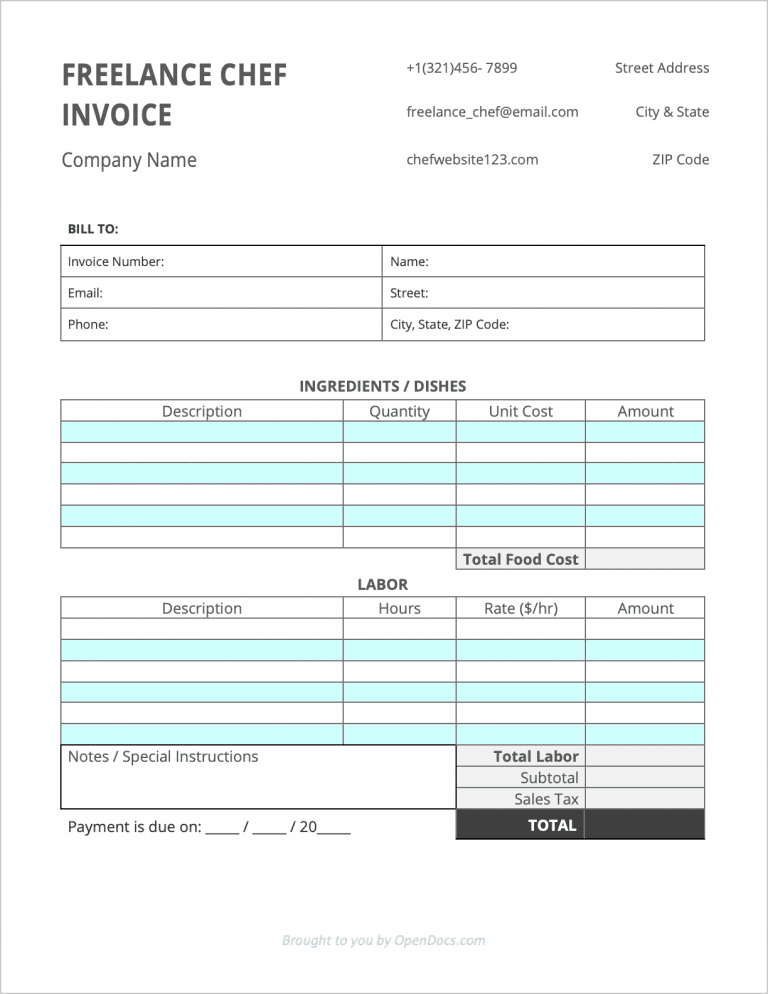
The lines on a chef’s invoice
A freelance chef invoice is written for a job with no printed menu price: the chef (the cook) agrees a figure with the client (the host, the family or the company), and the invoice is the first place the whole figure appears in one piece. A booking is priced one of two (2) ways. A dinner party or a catered lunch is priced per head, with the guest count on the line; a day of meal prep or a week in a private kitchen is priced per hour or per day. The groceries take a line of their own at cost, with the receipts behind them.
|
Publication 583 puts invoices on the IRS’s list of supporting documents, beside sales slips, receipts, deposit slips and canceled checks, and the documents behind gross receipts should show the amounts and sources. A chef keeps them until the period of limitations for that year’s return has run: three (3) years after the return is filed, as a rule, six (6) years when unreported income came to more than 25 percent of the gross income shown on the return, and with no limit at all when no return was filed.
Sales tax on prepared food and catering in four states
Whether tax goes on the total depends on the state.
| State | What the tax agency or the statute says |
|---|---|
| California | Regulation 1603(i) defines a caterer as a person in the business of serving meals, food or drinks on the customer’s premises or on premises the customer supplies, and leaves out employees the customer hires by the hour or the day. Tax applies to the caterer’s entire charge for serving meals, food and drinks, the food, the dishes, the tables and the labor of serving included, whether the caterer, its employees or a subcontractor does the serving, and to charges for preparing and serving meals even when the customer supplies the food. Since January 1, 2015 an optional tip or service charge is not taxed and a mandatory one is part of taxable gross receipts even when it is passed on to staff; where the caterer keeps no records reporting these amounts to the IRS, an amount negotiated with the customer before the meal or the event is mandatory (1603(h)(3)(A)). A caterer that separately states a charge for leasing property such as dishes is treated as the lessor of that property, and the lease is taxed under Regulation 1660 (1603(i)(3)(A)). |
| Texas | Tax Code 151.314(c-2) keeps the grocery exemption off prepared food: food and drinks served, prepared or sold ready for immediate consumption by restaurants, lunch counters, cafeterias, delis, hotels or like places of business, and food sold in a heated state or heated by the seller, with bakery items sold by a bakery excepted under (c-3)(1). The Comptroller’s list of taxable services, publication 96-259 (01/2026), counts catering among the taxable labor that is the processing of tangible personal property. Publication 94-111 (10/2006) leaves untaxed the charges of a self-employed person who provides household services such as cooking, but only when the person is an employee of the household and not a subcontractor for a third party such as a maid service. |
| New York | Tax Bulletin ST-110 treats, in general, every charge a caterer makes for a customer’s event as taxable, whether the event is at the caterer’s hall, a hotel or the customer’s home, and an expense the caterer passes on stays taxable even when it is listed on its own line. A caterer that only delivers the food and provides no service after delivery is taxed as a seller of food for off-premises consumption instead. Produce, seafood, meat and canned goods the caterer buys are not taxed, and cooked dishes, deli platters and soft drinks bought to resell can be bought tax free on Form ST-120. |
| Florida | Section 212.08(1)(c) (2026 edition) takes the food exemption away from food furnished, prepared or served for consumption at tables, chairs or counters or from trays, glasses, dishes or other tableware, whether the dealer or a person the dealer contracts with provides them, from hot prepared food products, and from food prepared on or off the premises and sold for immediate consumption, unless it was prepared off the premises and sold in its original sealed container or only sliced into portions. The premises of a caterer are wherever the meals are served (212.08(1)(d)3). |
Food handler training in Texas
The Department of State Health Services says all food employees complete an accredited food handler training course within thirty (30) days of employment, quoting Texas Food Establishment Rules 228.31, and counts as a food employee anyone working with unpackaged food, food equipment or utensils, or food-contact surfaces (food handler FAQ). The FAQ exempts a certified food manager, a food establishment that serves only prepackaged items and a temporary food establishment in DSHS jurisdiction; it also exempts, while a certified worker or food manager supervises, individuals with an intellectual disability, persons in a rehabilitation or correctional facility, persons who aid in activities of daily living, persons who distribute pre-portioned food in classrooms, daycare and similar settings, and volunteers the establishment does not employ. The card or certificate is good until the expiry date printed on it, or for two (2) years from issue when it carries none (25 TAC 229.178). Under Health and Safety Code 438.046(b-1), a worker trained in a course accredited by the American National Standards Institute, or accredited by the department and listed on its registry, has met a local health jurisdiction’s training, testing and permitting requirements. The FAQ adds that a card issued outside Texas is recognized when its program was ANSI accredited. Therefore a card from an accredited course is valid proof of training across the state, while a course given to the employees of a single entity meets a local health jurisdiction’s requirements only for food service performed for that entity (Health and Safety Code 438.046(b)), and under DSHS jurisdiction the certification must come from an accredited program.
Form 1099-NEC when a company pays the chef
A company, a nonprofit or a government agency that pays a self-employed chef for services in the course of its trade or business files Form 1099-NEC once the year’s payments reach $2,000, the threshold for tax years beginning after 2025, which may be adjusted for inflation from 2027. Payments to a corporation are generally exempt, and a family that pays for dinners at home makes a personal payment, which the form does not cover. A payment made with a credit or payment card or through a third-party network is reported on Form 1099-K by the payment settlement entity and stays off the Form 1099-NEC, and a payer that withheld federal income tax files the form whatever the amount paid. Copy A goes to the IRS and Copy B to the chef by January 31; for the 2026 forms that date is Monday, February 1, 2027, because the 31st is a Sunday. The chef’s taxpayer identification number comes from a Form W-9 handed over before the first payment, and a payer that holds no taxpayer identification number withholds 24 percent of each reportable payment until it has one.
An event with a guest list and serving staff can be billed on the catering invoice instead; other freelance trades are on the freelance invoice page, and every type is on the invoice templates hub.
Frequently asked questions
Is a service charge on a New York caterer’s bill taxed?
A mandatory gratuity escapes tax only when it is shown separately on the bill, labeled as a gratuity and handed over in full to the employees. A charge billed as a service charge, which caterers often add for parties above eight or ten guests, is taxed with the rest of the bill (Tax Bulletin ST-110).
Does Texas treat cold dishes dropped off unheated as prepared food?
Section 151.314(c-2)(3) counts two (2) or more food ingredients mixed or combined by the seller for sale as a single item as prepared food, even when sold unheated by weight or volume. Food that the seller only cuts, repackages or pasteurizes stays outside that definition.
Who keeps the Texas food handler certificate?
The food establishment keeps a certificate of completion for each food employee on the premises, on paper or electronically, ready for a regulatory authority (rule 228.31). A local health jurisdiction may not charge a fee for, or require, a local food handler card from a worker who shows proof of an accredited course (Health and Safety Code 438.046(c)).