
Freelance Editor Invoice Template
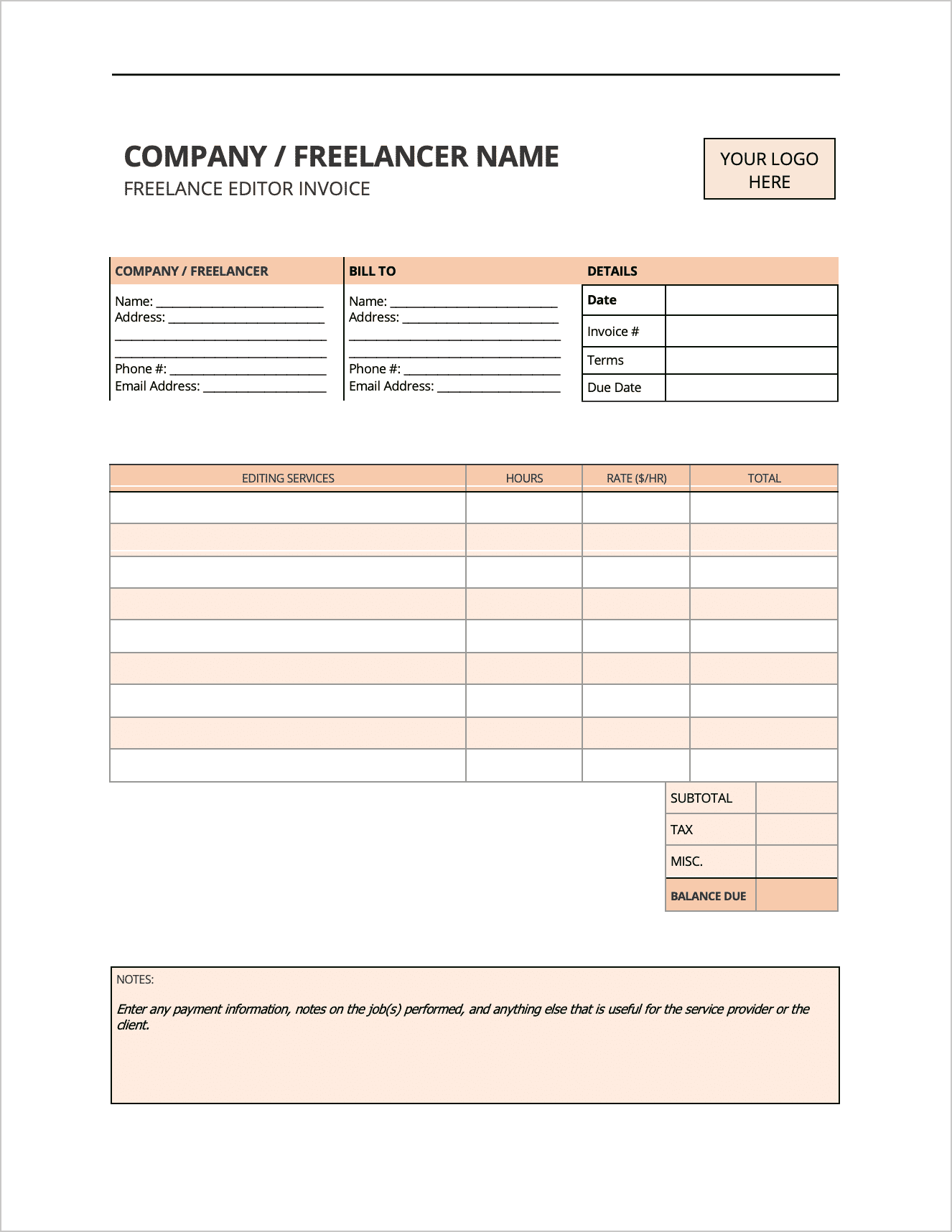
The Freelance Editor Invoice Template can be used by professional proofreaders to charge clients for their services. The layout of this invoice allows freelancers to convey accurate and simple billing information to their clients. The invoice is mainly comprised of a timesheet that includes a project description, hours billed, and rate per hour followed up by a total. The invoice cab be downloaded and easily customized for your practice below.
How to Become a Freelance Editor
Becoming a successful freelance editor revolves around one’s understanding of the English language. Having a college degree in a field related to English or Communications is an obvious advantage, however it’s not the only path to success in this industry.
Forming an LLC is ideal for starting a freelance editing practice. They’re easy to form and are relatively inexpensive. An LLC will protect personal assets and allows freelancers to avoid double taxation.
Start by taking low-level editing work. Freelance editors that are just starting should take jobs in which success is certain. After performing well at low-level editing jobs, freelance editors can put positive testimonials from former clients on their resume; opening doors to more advanced and better-paying editing jobs.
Once an editor has developed a reliable reputation in the market, they can decide their own hourly rates.
How Much Should a Freelance Editor Charge?
Depending on the complexity and type of editing work being done freelance editors’ hourly rates differ greatly. Entry-level basic copyediting work can pay anything from $14-30 per hour. Fact-checking and researching is more complex work and is worth about $40-75 hourly. The most advanced editing such as web design, newsletter editing, or audio editing can earn from $50-100+ per hour.