

Things to know
|
Types (6)

Durable
A durable power of attorney empowers an agent to oversee the principal’s financial and legal affairs on a continuing basis. The document remains legally binding even if the principal later loses the capacity to manage their own decisions.

General
A general power of attorney provides the agent with wide-ranging authority over the principal’s monetary and business concerns, including banking, estate management, and property transactions. The form is automatically revoked if the principal becomes incapacitated.

Limited (PDF)
A limited power of attorney narrows the scope of the agent’s authority to particular acts or decisions specified by the principal. It is commonly used when the principal requires assistance with a single matter, such as closing on a property.

Medical
A medical power of attorney allows the principal to appoint a health care agent who can make treatment decisions if the principal becomes unable to communicate. The agent is expected to act in accordance with the principal’s known preferences and values.

Minor Child
A minor child power of attorney transfers parental decision-making rights to a trusted adult on a temporary basis. It is often utilized by parents who are deployed for military service, incarcerated, or otherwise unable to provide direct supervision.

Motor Vehicle (REG 260)
A motor vehicle power of attorney (REG 260) is a California DMV form that authorizes an agent to conduct vehicle-related business, including title transfers, registration renewals, and the sale or purchase of a vehicle.
Signing Requirements
| Type | Requirement |
| Durable | Must be dated and signed by the principal, and either acknowledged before a notary public or signed by two adult witnesses; the statutory form requires the notary acknowledgment.[1][2] |
| General | The principal must date and sign the document, which must then be either notarized or signed by 2 adult witnesses.[2] |
| Limited | Requires the principal’s dated signature along with either notarization or the signatures of 2 witnesses.[2] |
| Medical | Signed by the principal and either acknowledged before a notary public or witnessed by 2 qualified adults. At least 1 witness must not be related to the principal.[3] |
| Minor Child | Must be signed by the parent or legal guardian. No specific execution statute exists, but notarization is advisable. |
| Motor Vehicle | The vehicle owner must sign the REG 260 form. No notarization is required by the DMV. |
Signing requirements
Under Probate Code § 4121, a power of attorney is legally sufficient when it contains the date of its execution, is signed by the principal (or in the principal’s name by another adult, in the principal’s presence and at the principal’s direction), and is either acknowledged before a notary public or signed by at least two witnesses.
Section 4122 sets the witness rules. Both witnesses are adults, the attorney-in-fact may not be a witness, and each witness must see either the principal sign or the principal acknowledge the signature or the document. A notary acknowledgment makes witnesses unnecessary.
| Step | Status |
|---|---|
| Date of execution | Required |
| Principal’s signature | Required |
| Notary acknowledgment or two adult witnesses | Required (one or the other) |
| Notary acknowledgment on the statutory form | Required |
| Agent signing as a witness | Not allowed |
| Court filing | Not required |
Durable wording
A power of attorney is durable only if it contains words showing that the agent’s authority continues despite the principal’s later incapacity. Section 4124 gives two model statements: “This power of attorney shall not be affected by subsequent incapacity of the principal,” and “This power of attorney shall become effective upon the incapacity of the principal.” Similar words that show the same intent also qualify. Acts the agent performs during the principal’s incapacity then bind the principal as if the principal had capacity (§ 4125).
The statutory form and the required warnings
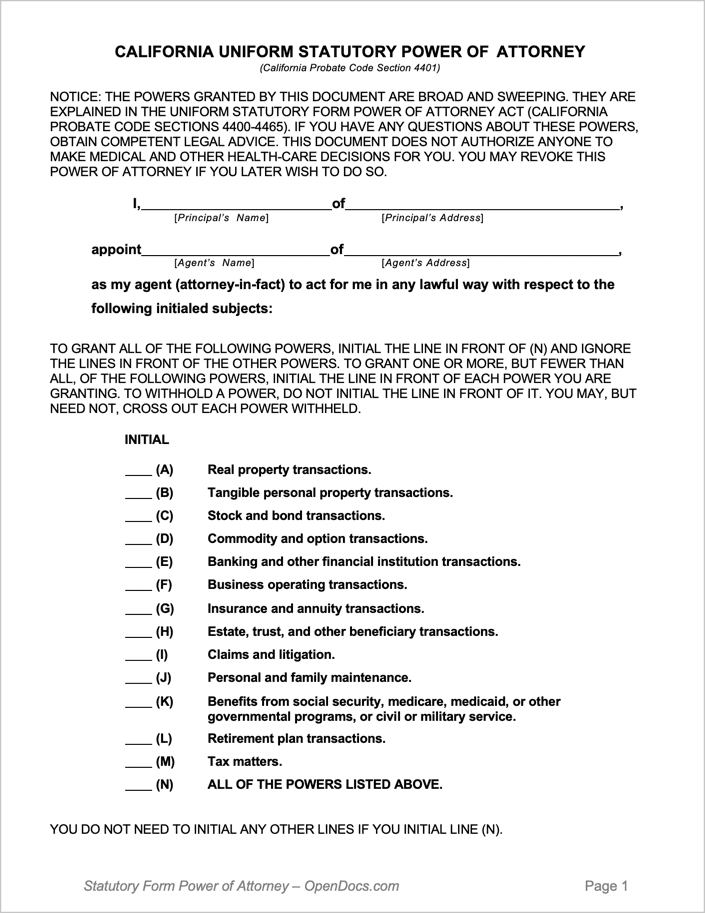
The Uniform Statutory Form Power of Attorney is set out in Probate Code § 4401. It is legally sufficient under § 4402 when the wording complies substantially with § 4401, the form is properly completed and the principal’s signature is acknowledged before a notary.
A printed durable power of attorney that is sold or distributed for use without a lawyer must carry the warning statements in § 4128 in boldface type of at least 10 points. One notice goes to the principal and one to the agent. The agent’s notice warns that transferring the principal’s property to oneself without express authority can bring prosecution for fraud or embezzlement, and for elder abuse when the principal is 65 or older.
Recording a power of attorney for real estate
Take the original to the recorder of the county where the property is located.
A county recorder accepts for recording an instrument that statute authorizes to be recorded, on payment of the proper fees and taxes, if it carries an original signature and can be indexed and reproduced (Government Code § 27201). The notice in § 4128 says that a durable power of attorney affecting real property should be acknowledged before a notary public so that it can be recorded easily.
Fees are set by county. For example, the Sacramento County Clerk/Recorder charges $20 for the first page and $3 for each additional page, and says some documents also pay a $75 Building Homes and Jobs Act fee unless an exemption applies.
Health care directive form
A power of attorney for health care is Part 1 of the statutory Advance Health Care Directive form in § 4701. Under § 4673 the directive is dated, signed by the patient, and either notarized or signed by two witnesses. Those witnesses must be adults and cannot be the patient’s health care provider or the provider’s employee, the operator or an employee of a community care facility or residential care facility for the elderly, or the agent (§ 4674).
At least one witness must be neither related to the patient by blood, marriage or adoption nor entitled to any part of the estate. A patient in a skilled nursing facility needs a patient advocate or ombudsman as a witness (§ 4675). An electronic directive requires a notary acknowledgment.
Ending a power of attorney and revoking it
Under § 4152, the agent’s authority ends by its own terms, when its purpose is fulfilled, on revocation, on the principal’s death, on the agent’s removal, resignation, incapacity (temporary incapacity only suspends it) or death, and on dissolution or annulment of the marriage of the agent and principal. Under § 4153 the principal revokes by telling the agent orally or in writing that the authority is revoked. A third person who has no notice of the revocation is protected.
What the agent owes the principal
An agent has no duty to act until the agent agrees in writing, but one who starts a transaction must finish it (§ 4230). From then on the agent follows the prudent person standard for the principal’s property (§ 4231), acts solely in the principal’s interest (§ 4232), keeps the principal’s property separate (§ 4233) and stays in regular contact (§ 4234). Gifts, creating or changing a trust, survivorship interests, beneficiary designations and a loan to the agent all need express authority in the document (§ 4264).
Frequently asked questions
Does a California power of attorney need a notary?
Not always. Section 4121 accepts two adult witnesses in place of a notary acknowledgment. However, the statutory form requires the acknowledgment, and § 4128 advises a notary acknowledgment on a durable power of attorney that may affect real property so that it can be recorded easily.
Can a family member witness a California power of attorney?
Yes for a financial power of attorney, as long as the family member is an adult who is not the agent. For an Advance Health Care Directive, at least one of the two witnesses must be unrelated to the patient and not an heir.
Does a California power of attorney continue if the principal becomes incapacitated?
Only if it is durable under § 4124. A power of attorney without such words is not durable. A durable one continues, and the agent’s acts bind the principal.