

Things to know
|
Versions (3)

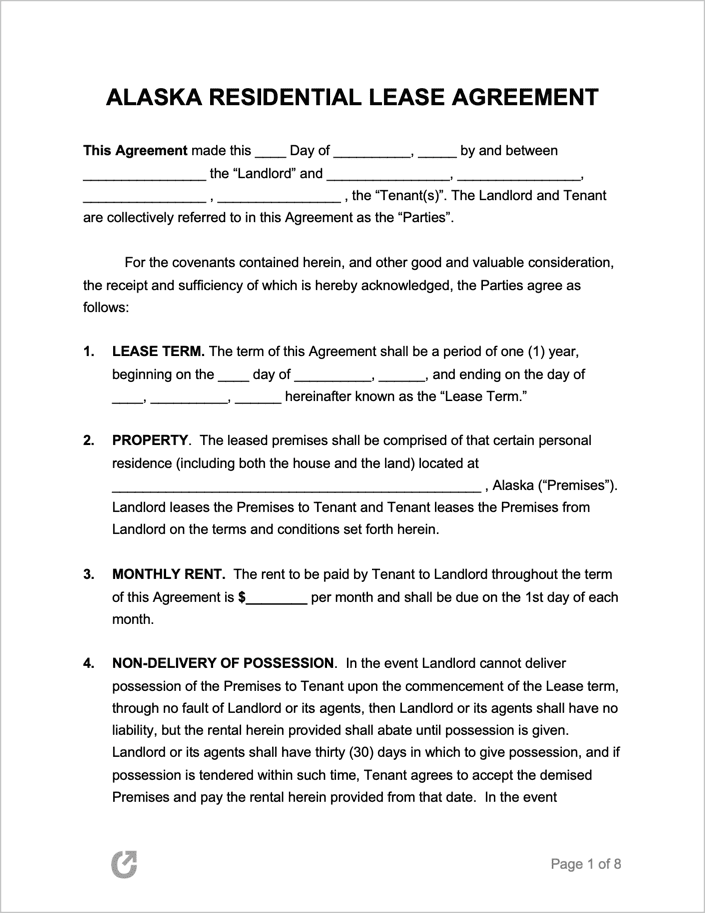
Download: PDF, Word (.docx)
Download: PDF, Word (.docx)

Download: PDF
Alaska Lease Laws
Laws: Uniform Residential Landlord Tenant Act
Maximum Security Deposit (§ 34.03.070): Landlords cannot request prepaid rent or a security deposit exceeding two months’ rent, except when the monthly rent surpasses $2,000.
Returning Security Deposit: Provided the tenant or landlord has given proper notification regarding tenancy termination, the landlord must mail the itemized statement and refund within fourteen (14) days after the tenancy ends and the tenant delivers possession, or within thirty (30) days when the landlord deducts for damage from the tenant’s noncompliance with AS 34.03.120. If the tenant does not give that notice, the landlord must mail the itemized statement and refund within thirty (30) days after the tenancy ends, possession is delivered or the landlord learns the unit is abandoned.
Additional Security Deposit For Pets: Landlords may request an additional security deposit for tenants with pets, excluding service animals. This amount cannot exceed one month’s rent and may only go towards damages caused by the pet.
Writing and signing an Alaska lease
Under AS 09.25.010(a)(6), an agreement to lease for longer than one (1) year is unenforceable unless it, or some note or memorandum of it, is in writing and subscribed by the party charged or that party’s agent. When an agent signs for the party, the agent’s authority must itself be in writing (AS 09.25.010(a)(7)). Nothing in that section or in AS 34.03 calls for a notary or a witness.
A written lease that only one side signed can still bind both. If the tenant signs and delivers it and the landlord then accepts rent without reservation, the lease takes effect as if the landlord had signed; if the landlord signs and the tenant takes possession and pays rent, the same applies to the tenant. A lease given effect this way runs for at most one (1) year even if it names a longer term (AS 34.03.030). With no term in writing, a tenant who pays weekly holds week to week and every other tenant month to month (AS 34.03.020(d)).
| Item | Requirement | Section |
|---|---|---|
| Signature of the party to be charged, lease over one year | Required | AS 09.25.010(a)(6) |
| Written authority for an agent who signs | Required | AS 09.25.010(a)(7) |
| Premises condition statement | Included when the landlord requires one; the tenant signs to acknowledge it | AS 34.03.020(e), 34.03.090(b) |
| Witness | Not required | AS 34.03, AS 09.25.010 |
| Notary | Not required | AS 34.03, AS 09.25.010 |
Clauses the Act will not enforce
Strike any of these from a lease before signing it.
|
Such a clause is unenforceable, and a party who wilfully uses a lease with a clause it knows is prohibited owes the other party’s actual damages (AS 34.03.040).
Disclosures before the tenant moves in
At or before the start of the tenancy the landlord, or whoever signs for the landlord, gives the tenant in writing the name and address of the person who manages the premises and of an owner or a person authorized to accept service of process, notices and demands. The information is kept current, and a person who skips it becomes the agent of every landlord for service and for carrying out the landlord’s duties (AS 34.03.080).
For most housing built before 1978, federal law adds a step before the tenant signs: the landlord hands over the EPA pamphlet on lead, discloses any known lead-based paint or hazards with the reports it has, and attaches a lead warning statement to the lease. The rule skips zero-bedroom units (unless a child under six lives there), leases of one hundred (100) days or less with no renewal, housing certified free of lead-based paint, and housing for the elderly or persons with disabilities (unless a child under six lives there); the landlord keeps the signed disclosure for three (3) years. Knowing violations cost the landlord three (3) times the tenant’s damages, and a court may add the tenant’s costs and attorney fees if the tenant prevails (42 U.S.C. 4852d(b), 40 CFR 745.118).
Deposit rules the cap does not cover
Prepaid rent and deposits go promptly into a trust account at a bank, savings and loan or licensed escrow agent, wherever practicable, and the landlord gives the tenant the terms under which the money may be withheld. Each tenant’s funds are accounted for separately, never mixed with the landlord’s other funds and never used for another tenant’s rent, damages or refund (AS 34.03.070(c)).
When the tenancy ends the landlord may apply the money to accrued rent and to damage from the tenant’s breach of AS 34.03.120, which means deterioration of the premises and their contents other than normal wear and tear or conditions the landlord caused. The accrued rent and damages are itemized in a written notice mailed to the tenant’s last known address, with the balance due (AS 34.03.070(b)). A landlord who wilfully fails to do this can be made to pay up to twice the amount withheld (AS 34.03.070(d)), and whoever holds the landlord’s interest when the tenancy ends is bound by the same section (AS 34.03.070(f)).
Notice periods under the Act
Most periods below run from service of a written notice; each row says what its period is counted from. A notice to quit may be handed to the tenant, left at the premises if the tenant is absent, or sent by registered or certified mail (AS 09.45.100(c)), and when the landlord mails it, three (3) days are added to the period before the tenant is treated as holding over unlawfully (AS 09.45.090(c)).
| Situation | Notice | Section |
|---|---|---|
| Either party ends a week-to-week tenancy, rent current | Written notice at least fourteen (14) days before the termination date | AS 34.03.290(a) |
| Either party ends a month-to-month tenancy | Written notice at least thirty (30) days before the rental due date named in it | AS 34.03.290(b) |
| Rent unpaid | Seven (7) days after written notice of nonpayment and intent to terminate; one notice per default | AS 34.03.220(b) |
| Material breach of the lease or of the tenant’s duties affecting health and safety | Notice to quit ending the lease not less than ten (10) days after service; no termination if the tenant cures first; a repeat within six (6) months gets five (5) days | AS 34.03.220(a)(2) |
| Deliberate damage over $400, or prostitution or other listed illegal activity at the premises | Notice to quit ending the lease between twenty-four (24) hours and five (5) days after service | AS 34.03.220(a)(1) |
| Utility cut off because the tenant did not pay the utility | Lease ends five (5) days after service unless the tenant restores service and repays the landlord within three (3) days and no damage resulted | AS 34.03.220(e) |
| Landlord enters the unit | At least twenty-four (24) hours’ notice, reasonable times, tenant’s consent, except in an emergency or when notice is impracticable | AS 34.03.140(c) |
| Landlord’s material breach or failure to keep the unit fit | Tenant’s written notice ending the lease not less than twenty (20) days after receipt unless the landlord cures within ten (10) days | AS 34.03.160(a) |
| Either side ends the lease over abuse of access | Written notice at least ten (10) days before the date named | AS 34.03.300 |
The Act sets no notice period for a rent increase. The Department of Law’s landlord and tenant booklet calls a rent increase notice probably equivalent to a termination at the old rent plus an offer at the new one, and advises the landlord to give the thirty (30) days’ notice of AS 34.03.290(b) before the increase takes effect, with a tenant who would rather leave giving the same notice. The booklet adds that during a lease the landlord cannot raise the rent unless the lease provides for it or the tenant breaks its terms.
Late fees
Rent is due without demand at the time and place the lease names, and otherwise at the unit at the start of each month (AS 34.03.020(c)). The Act says nothing about late charges or returned-check fees. The booklet’s view is that a small flat fee which approximates the landlord’s actual cost may be lawful if the lease agreed to it in advance, and that a tenant who is current on rent cannot be evicted for unpaid late fees.
Eviction: forcible entry and detainer
A landlord who wants possession files a forcible entry and detainer action under AS 09.45.060 to 09.45.160. The seven-day nonpayment notice counts as the notice to quit, so no second notice is served (AS 09.45.100(b)); any other notice to quit names the breach, the cure and its deadline, and the date and time the tenancy ends (AS 09.45.105). The action may be filed on or after the day the tenant holds over unlawfully (AS 09.45.110), and the summons is served at least two (2) days before trial (AS 09.45.120). The booklet describes a possession hearing set within fifteen (15) days of filing, with no jury, and a later damages hearing where either side may ask for one. Attorney fees go to the prevailing party in any proceeding under the Act or a rental agreement (AS 34.03.350).
Penalties for skipping the process
A landlord may not take back the unit by lockout, by cutting electricity, gas, water or another essential service, or in any way other than abandonment, surrender, energy conditions beyond the landlord’s control or the Act’s own procedures (AS 34.03.280). A tenant who is unlawfully removed or whose services are wilfully cut may recover possession or end the lease and, either way, recover up to one and one-half (1.5) times actual damages (AS 34.03.210). A landlord who enters unlawfully, enters in an unreasonable manner or harasses the tenant with repeated demands can be enjoined or the tenant can end the lease; the tenant may also recover up to the greater of actual damages or one (1) month’s rent, with court costs and attorney fees (AS 34.03.300(b)).
A tenant who stays on without consent after the lease ends can be sued for possession after a notice to quit, and a wilful holdover in bad faith adds up to one and one-half (1.5) times the landlord’s actual damages (AS 34.03.290(c)).
Frequently asked questions
Does an Alaska lease have to be notarized or witnessed?
No section of AS 34.03 or AS 09.25.010 requires either. Past one (1) year, the lease needs a writing signed by the party to be charged, or by an agent whose authority is also in writing.
How much notice does an Alaska landlord give before entering?
At least twenty-four (24) hours, at a reasonable time and with the tenant’s consent, unless there is an emergency or notice is impracticable (AS 34.03.140(c)). During a tenant’s absence of more than seven (7) days the landlord may enter at times reasonably necessary (AS 34.03.230(b)).
What happens when rent is late in Alaska?
The landlord serves a written notice of nonpayment, and the tenancy ends if the full rent is not paid within seven (7) days, unless the landlord agrees to let the tenant stay (AS 34.03.220(b)). A mailed notice gets three (3) extra days (AS 09.45.090(c)).
Can an Alaska landlord keep the deposit for cleaning?
Only for deterioration beyond normal wear and tear, itemized in the mailed statement (AS 34.03.070(b)). On moving out the tenant leaves the unit in substantially its move-in condition, which at the landlord’s discretion includes professional carpet cleaning if the carpets were professionally cleaned right before the tenancy (AS 34.03.120(c)).