
Alaska Rental Lease Agreement Templates

An Alaska rental lease agreement is a contract used for renting space to one (1) or more tenants. Being legally-binding forms, they require the tenant(s) to pay a regular fixed payment on a weekly or monthly basis until the end of the lease. It can be used for the renting of a house, apartment, room, basement, office, or other residential or commercial property. Although each contract is different in certain ways, they typically contain provisions such as monthly rent, the term of the lease, and obligations of the landlord and tenant(s). It is highly recommended that any edited or newly issued agreement is approved by a licensed attorney before signatures are recorded.
Types (6)
| Commercial | Lease-to-Own | Monthly | Roommate | Standard | Sublease |
Which Form is Right for Me? | |
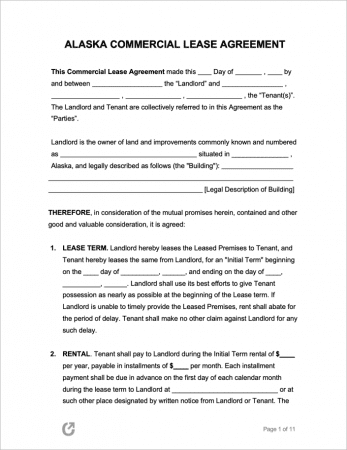
| Commercial | For leasing a property that will be used for business purposes. |
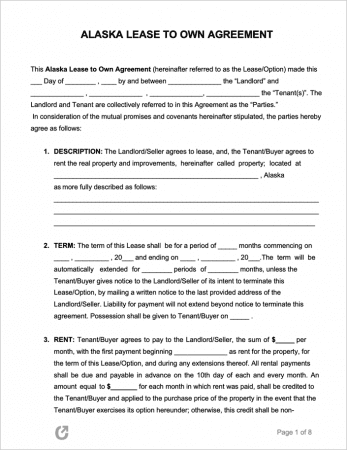
| Lease-to-Own | A lease that gives the tenant the option to purchase the property at the end of the lease term. |
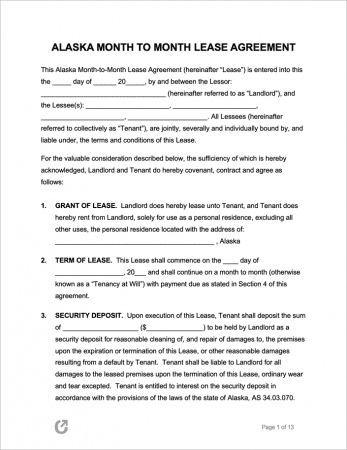
| Month-to-Month | Does not have a set end date – needs to be renewed every thirty (30) days. |
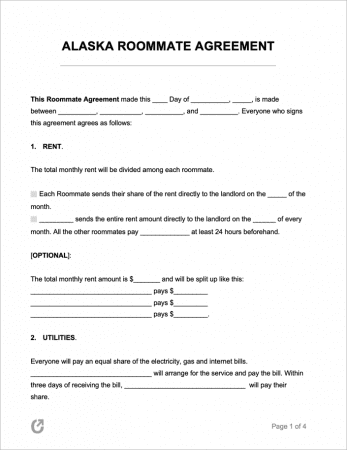
| Roommate | Signed by tenants living within the same rented property; covers non-legal tasks such as cleaning and guest policy. |
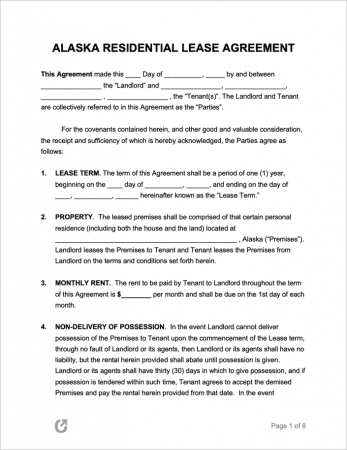
| Standard Lease | For leasing a property with a time span of roughly one (1) year. |
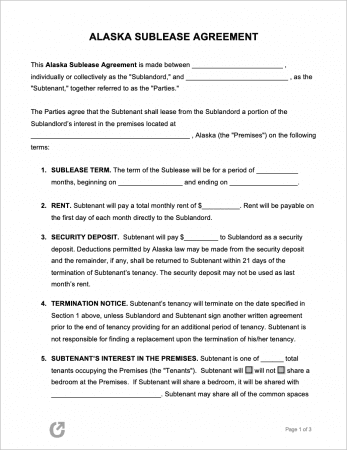
| Sublease | Gives tenants that have already committed to a lease the option to have another party live and pay rent in the property. |
Screening Potential Tenants
Before signing a lease, landlords should screen prospective tenants using a rental application to look for any warning signs, such as previous evictions, bankruptcies, and other issues that could indicate the applicant is a poor-quality tenant.
State Laws & Guides
- Laws: Alaska Uniform Residential Landlord and Tenant Act
- Guide to Landlord-Tenant Law: The Alaska Landlord & Tenant Act: What it Means to You (PDF)
When is Rent Due?
According to § 34.03.020, unless explicitly stated in the agreement, rent is payable at the beginning of the term (if less than one (1) month-long term) and otherwise in monthly payments. It should be due on the same day every month.
Landlord’s Access
Emergency (§ 34.03.140(b)) – Landlord may access the premises with no notice to the tenant.
Non-Emergency (§ 34.03.140(c)) – Landlord must give at least twenty-four (24) hours’ notice to the tenant for any inspection, repair, or to show the property to another prospective tenant.
Landlord’s Duties
As required by § 34.03.100, landlords are required to provide the following:
- Repairs: It is the landlord’s responsibility to make any and all repairs to the rental and surrounding areas to ensure it is safe for tenants.
- Cleaning: Keep the common areas clean and safe for living.
- Garbage: Provide tenants with a means of getting rid of their trash and other waste.
- Smoke Detectors: Provide tenants with both smoke and carbon monoxide detectors.
- Locks: Provide and maintain locks and keys if requested by the tenants.
- Water: Ensure tenants have both running, heated water and heat, except in cases where it is waived in the lease, or in the case that water is solely under control of the tenant.
Tenant’s Duties
Per § 34.03.120, tenants are required to comply with the following:
- Cleaning: Keep their rental clean and livable.
- Trash Disposal: Throw away all trash and rubbish in a safe manner.
- Plumbing: Ensure plumbing fixtures are kept clean.
- Appliances & Facilities: Use all appliances, heating and cooling systems, and facilities in how they are meant to be used.
- Destruction of the Premises: Refrain from purposely (or negligently) damaging the rental property or included common areas.
- Keep the Peace: Do not disturb neighboring tenants with excessive noise or by other means.
- Smoke Detectors: Do not remove and maintain all installed smoke and carbon monoxide detecting units.
- Locks: Tenants cannot change the locks on the property without first contacting the landlord and obtaining a written agreement to do so. In emergencies, tenants can change the locks immediately and provide the landlord with a notice that the locks were changed and a set of the keys, so long it is done within five (5) days.
- Occupants: Do not exceed the number of occupants living in the property as stated by law, the lease agreement, or an established covenant.
- Fees: Neither the tenant nor their guests can cause the landlord to be faced with a fee issued by the municipal government, as stated by § 29.35.125.
Required Disclosures
Extended Absence (§ 34.03.150): Unless otherwise agreed, the tenant is to notify the landlord if they should not be on the premises for a period lasting more than seven (7) days.
Subleasing (§ 34.03.060): Tenants cannot sublease a rental unless given strict permission from the landlord.
Landlord Identification (§ 34.03.080): Landlord is required to detail in the rental agreement (1) the name of the individual authorized to manage the property, if not the landlord (2) name of the individual authorized to act in the presence of the landlord for sending and receiving notices and (3) that the information must be kept current and if any change should occur that the tenant is to be made aware of such change.
Retaliation (§ 34.03.060): Landlords cannot retaliate to tenants by raising rent, refusing to lease, or other unfair actions if a tenant joined a tenants’ union, made prior complaints citing a breach of any of their tenants’ rights, or made a formal complaint regarding one of the landlord’s duties.
Security Deposits
Maximum (§ 34.03.070(a)): The landlord may not accept a security deposit that is greater than two (2) months’ rent. If the monthly rent is more than two thousand dollars ($2,000) then there is no limit to the deposit amount.
Returning to Tenant (§ 34.03.070(g)): The landlord is required to refund the deposit at the end of tenancy within fourteen (14) days after termination and possession has been delivered by the tenant.