
New Jersey Rental Lease Agreement Templates
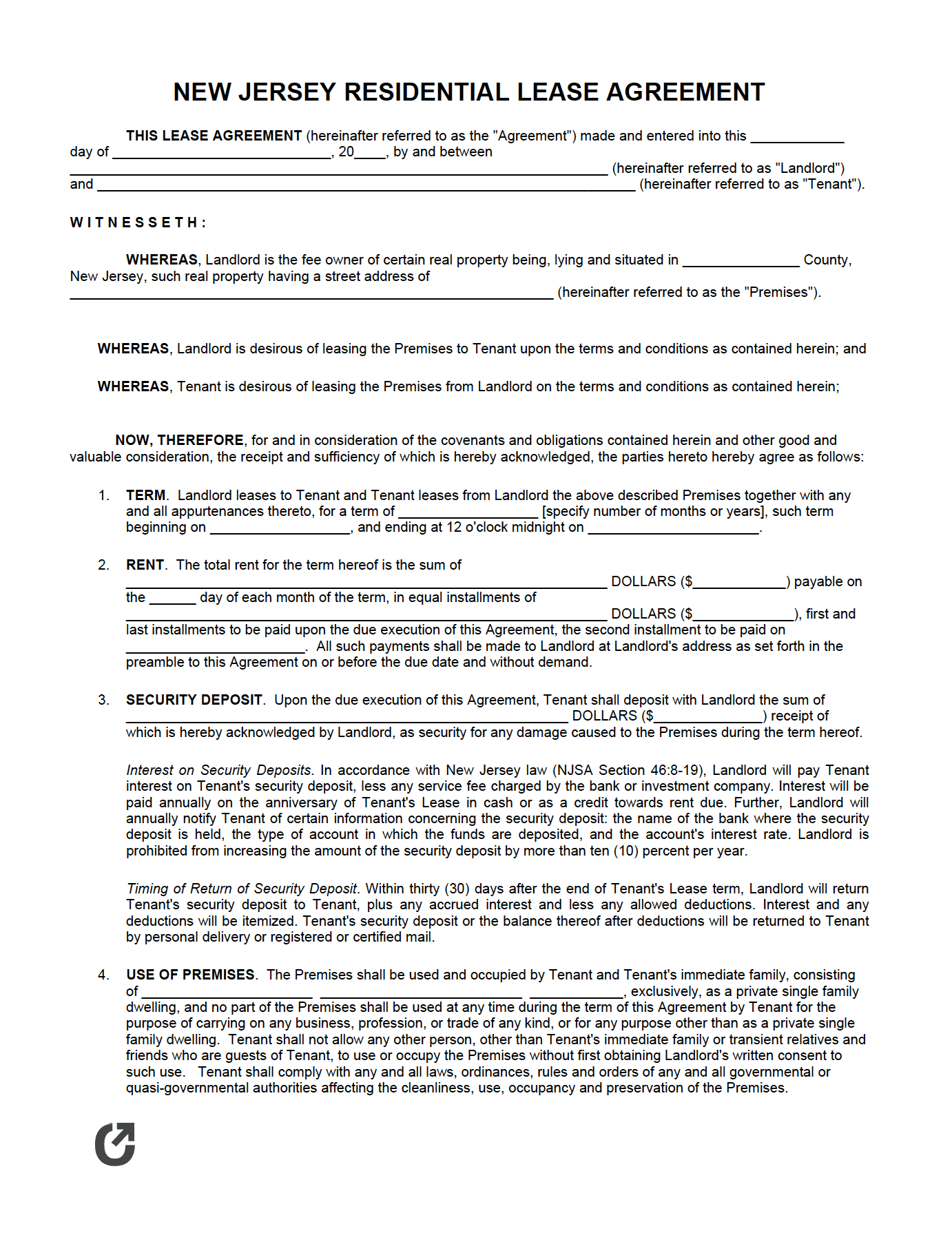
A New Jersey Rental Lease Agreement is a contract that permits a property owner to legally allow a tenant to live in their property in exchange for set payments.
The agreement covers many important subjects related to renting, including security deposit information, rent due dates, the lease term, details on the property, and much more. Once downloaded, the landlord can make any necessary edits to account for anything unique to their renting situation.
Types (6)
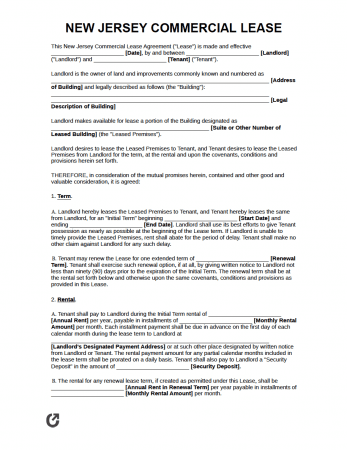 Commercial Lease Agreement – For property managers of commercial property, the agreement sets conditions regarding the rental of property to a business or franchise owner.
Download – PDF, Word (.docx)
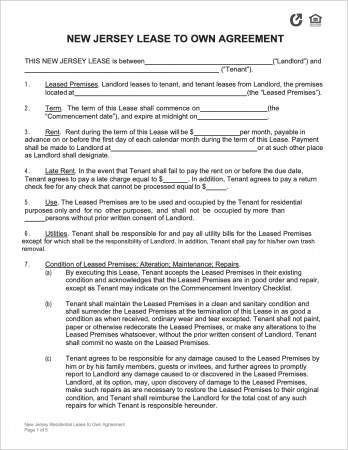 Lease to Own Agreement – A contract used by those selling a home to establish a situation in which their property is initially leased, and later purchased by the tenant(s). It’s important to note that the tenants have the option, not the requirement, to purchase the home.
Download – PDF, Word (.docx)
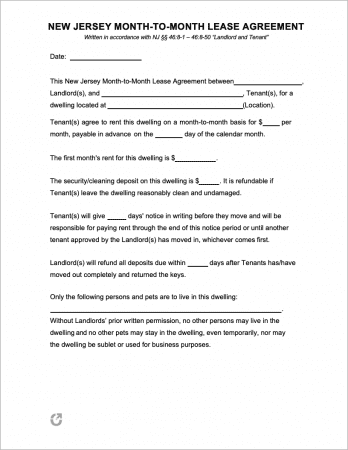 Month-to-Month Lease Agreement – A short-term lease that renews on a monthly basis. It is preferred by landlords who do not wish to (or cannot) commit to a long-term (1+ year) lease.
Download – PDF, Word (.docx)
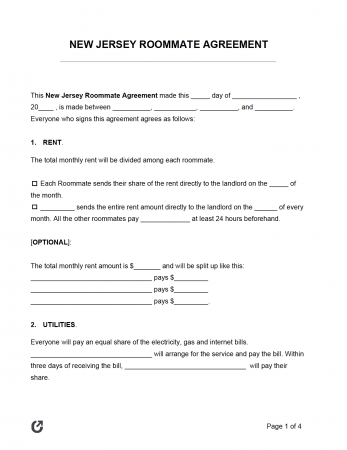 Roommate Agreement – A form used for preventing disagreements and conflicts among roommates sharing the same rented property. Once it has been completed, it should be read and signed by all roommates to provide that everyone is on the same page.
Download – PDF, Word (.docx), Rich Text (.rtf)
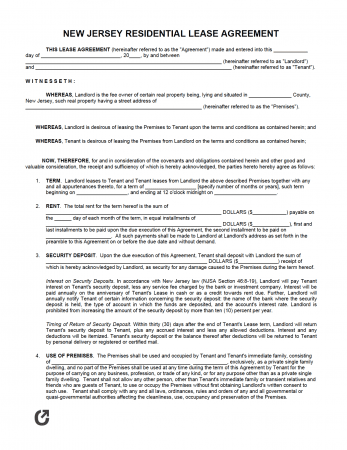 Standard Residential Lease Agreement – Used for leasing apartments, homes, rooms, and any other non-commercial property. Has a typical lease contract length of one (1) year, although the landlord and tenant(s) can negotiate a shorter or longer-term if they wish.
Download – PDF, Word (.docx)
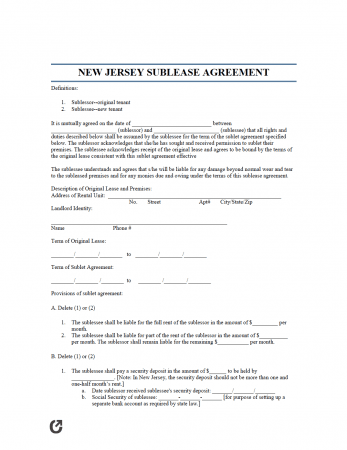 Sublease Agreement – A contract created to establish legal terms that allow for a tenant to lease part or all of their rental dwelling to another party.
Download – PDF, Word (.docx)
What is a New Jersey Lease Agreement?
A New Jersey Lease Agreement is a property management document used for legally renting out a unit or entire property. Once signed by a landlord and tenant, it serves as a reference to each party’s legal responsibilities to one another. Landlords are advised to require all parties interested in signing a lease to fill out a rental application, which provides landlords with a summary of the applicant’s background, character, and relevant experiences.
State Laws & Guides
Laws: Title 46, Chapter 8 “Landlord and Tenant”
Landlord-Tenant Guides / Handbooks
- New Jersey Truth in Renting Guide.pdf
- Tenants’ Rights in New Jersey.pdf
- New Jersey Information for Residential Tenants.pdf
When is Rent Due?
There is no state-required date rent must be paid by. Therefore, the due date of rent should be clearly outlined in a written rental agreement.
Landlord’s Access
Emergency (New Jersey – Right of Entry Bulletin): In emergency situations in which there is an immediate threat to the safety or health of the tenants in or near the rental, landlords are not required to give notice prior to entering.
Non-Emergency (§ 5:10-5.1(c)): Landlords need to provide tenants with one (1) days’ notice prior to entering their rental for the purposes of inspection and/or maintenance.
Required Disclosures
- Flood Zone Disclosure (§ 46:8-50): Landlords must disclose if the rental is located in a flood zone or area.
- Lead Paint Disclosure: To be compliant with federal law, landlords must disclose to tenants if their rental property built before 1978 has any known lead paint hazards. The law also requires landlords to provide tenants with a copy of a pamphlet that further discusses the subject.
- Truth in Renting Act (Truth in Renting Act 46:8-46): The Truth in Renting Act requires landlords to distribute the current annual statement made by the New Jersey Department of Community Affairs regarding the rights and responsibilities of tenants and landlords within the State. The statement must be distributed to all tenants with a rental term of at least one month who are living in residences with more than two (2) rental units. They must also make the current statement available in the building where the tenants can easily find it.
- Window Guards (55 § 13A-7.14(b.)(1)): The landlord of a rental unit in a multiple dwelling space must verbally inform the tenant of their right to request the installation of window guards. This must also be set forth in a written document acknowledging that the tenant was aware of this right.
Security Deposits
Maximum (§ 46:8-21.2): Landlords may not demand more than one-and-a-half (1.5) times the equivalent of one (1) month’s rent as a security deposit. If the landlord chooses to collect an additional security deposit (if the tenant leases the property for over a year), the annual amount cannot be more than ten percent (10%) of the current security deposit.
Returning to Tenant (§ 46:8-21.1): The security deposit (with any accrued interest), must be returned by the landlord within thirty (30) days after the ending of the lease.
Deposit Interest (§ 46:8-19): Required to be collected and paid to tenants.