

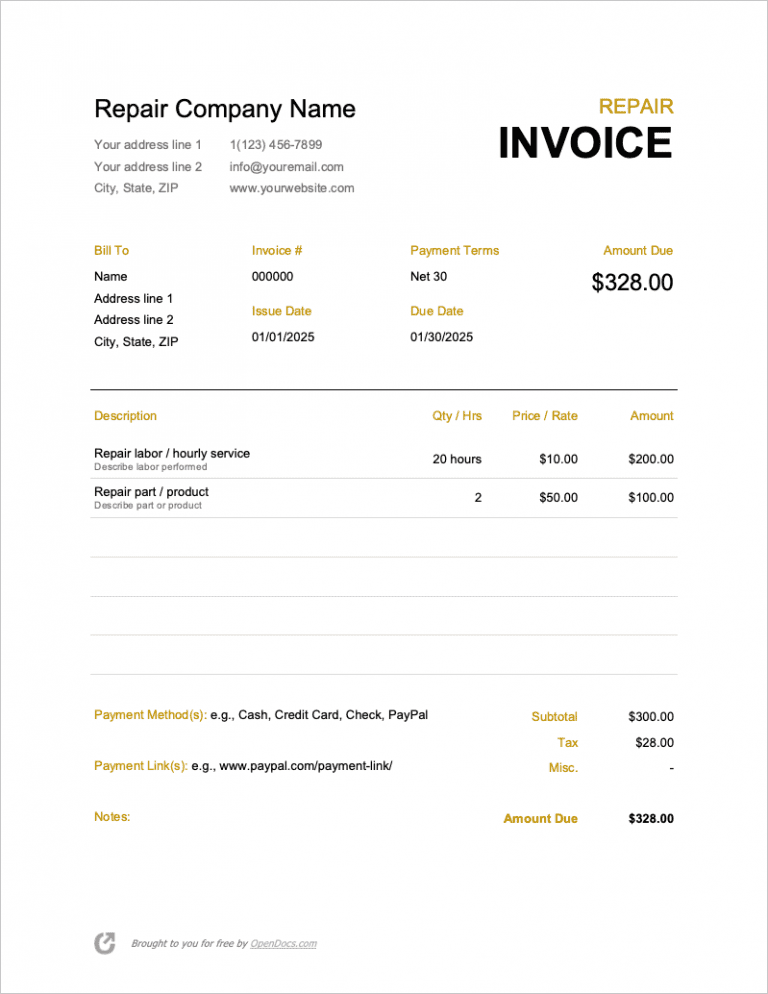
Things to know
|
Types (11)

For listing the cost of all labor and/or parts that went into fixing a customer’s motor vehicle.

A form that can be used by both body shop companies and freelance body shop specialists to bill customers for bodywork performed on a car, motorcycle, or another type of vehicle.
Use for providing a breakdown of the labor and parts that went into repairing a phone. Compatible with any phone type, including iOS and Android.

Used by professional electricians to bill their clients, whether it is for work performed in the commercial, residential, automotive, or another industry.
A billing document published for anyone that performs work “around the house”, such as repairing faucets or windows, hanging lights, moving furniture, painting, and much more.
 HVAC Invoice – Lists any and all labor + material costs that went into the maintenance or repair of a Heating, Ventilation, and Air Conditioning (HVAC) system.
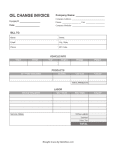
A simple form for listing the time (labor) as well as the costs of the oil, filter, and any other required parts or products.
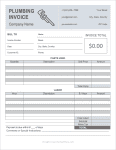
Gives professional and part-time plumbers a means of getting paid for their work. Contains space for writing down any and all labor or product costs (e.g., fixtures, pipes, fittings, and so on).
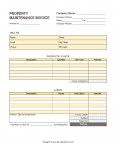
A document that can be used for billing the cost of labor and/or materials after performing work on single-family homes, rentals, and any other property type.
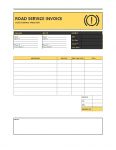
A specifically designed form for companies and workers that provide emergency roadside repair. Can be used for receiving payment for jumpstarts, battery replacements, fuel delivery, lockouts, and more.
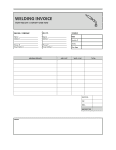
A post-job form used by welders to inform clients of the service(s) they performed, the cost of any materials used, and the total outstanding amount ($) that will need to be paid.
How to Charge for Repair Work
Follow the tips below to charge customers for repair work of any type.
1. Determine Repair Type
A technician typically assesses an item before repairing it. This step notifies the customer of what needs fixing and how much money it will cost. After the appraisal, the customer must approve the repairs. As soon as they sign or formally agree to the work, the technician can begin their duties.
2. Gather Products or Materials
The technician or company must purchase all of the materials needed to perform the repairs. When buying the products, they need to record each item and its price in the invoice. It is the responsibility of the customer to pay for the parts at the end of the service.
3. Calculate Labor Cost
Repair companies typically charge by the hour for a standard fee. The type of service performed affects the hourly rate.
The estimate before the work: Ohio’s two rules
Two (2) parties meet on a repair invoice: the supplier (the shop or technician) and the consumer (the owner of the item). Ohio’s consumer protection rules put the estimate at the start of that meeting. Under rule 109:4-3-05, when the anticipated cost of a repair or service is more than $25 and the consumer and the supplier met face to face before the work began, the supplier hands over a form at that first meeting showing the date, the supplier’s identity, the consumer’s name and telephone number, the reasonably anticipated completion date and, when the consumer asks for it, the anticipated cost. The form carries an “Estimate” disclosure where the consumer initials one of three (3) choices: a written estimate, an oral estimate or no estimate. A shop that does none of the work at the consumer’s home either posts a sign where repair customers are sent or gives a separate form with the rule’s “Notice”: the bill will not exceed the estimate by more than $5 or 10 percent, whichever is greater, unless the consumer approves a larger amount before the repairs are finished. When part of the work happens at the residence, the supplier tells the consumer orally of the right to an estimate and still gives the form, and the job is not treated as started until the supplier arrives at the home. In place of paragraphs (A), (B) and (C) a supplier may instead give, before any work, a written quotation of the price that it states is binding for five (5) days, provided the item is made available for the repair within that period (paragraph (G)).
The rule does not stop at the estimate. Where an estimate was requested and the anticipated cost was $50 or less, the supplier needs the consumer’s oral or written authorization before adding unforeseen but necessary repairs that cost more than $5 excluding tax; where the anticipated cost was over $50, the authorization is needed once the extra repairs reach 10 percent or more (excluding tax) of the original estimate. A charge for any repair the consumer did not authorize is itself a deceptive act. So is a failure to disclose, at the first contact, any charge that is not directly related to the repair, such as a service charge, a travel charge for coming to the residence or a diagnosis charge, whether or not the repair goes ahead. At the end the consumer gets a written itemized list of the repairs performed or services rendered, with the parts or materials and a statement of whether they are used, remanufactured or rebuilt if not new, their cost, the amount charged for labor and the identity of the person who did the work (paragraph (D)(12)). Replaced parts are tendered to the consumer unless the supplier will rebuild or sell them, or return them to the manufacturer under a warranted repair, and that reuse was made known before the work started. The rule has no application to motor vehicles (paragraph (H)); those have their own.
Rule 109:4-3-13 is the motor vehicle version, in force since March 21, 2026. Its threshold is $50, the face-to-face contact has to happen at the supplier’s place of business during the hours repairs are offered, and the notice reads that the bill will not be higher than the estimate by more than 10 percent unless the consumer approves a larger amount before the repairs are finished. A consumer who makes a supplier-authorized delivery of a vehicle during non-business hours gets a form in duplicate on which to sign for a written estimate, an oral estimate or no estimate and to leave a telephone number. The basis of any towing charge is disclosed at the first contact (paragraph (C)(7)), and the itemized list, the replaced parts and the receipt for a vehicle left at the shop follow the same pattern as the general rule. The California, New York, Florida and Washington vehicle statutes, with their own estimate thresholds, are on the auto repair invoice page.
The lines on a repair invoice
|
Sales tax on repair labor and parts in four states
| State | What is taxed on a repair of personal property | Source |
|---|---|---|
| Texas | Personal property maintenance, remodeling or repair services are taxable services under Tax Code 151.0101; the Comptroller’s examples are shoe shining or repair, appliance repair, furniture refurbishing or upholstering, jewelry repair or cleaning and dog grooming. | Comptroller publication 96-259 |
| Florida | When repairing or improving tangible personal property the repairer buys the repair materials tax-exempt for resale and charges the customer tax on labor and materials if parts are used in the repair; a labor-only job is not taxable, but the repairer must document that no parts or other items were incorporated into or attached to the repaired item. | Department of Revenue, GT-800067 |
| New York | Sales of services are generally exempt unless specifically taxable, and maintaining, installing, servicing and repairing tangible personal property is on the taxable list. | Tax Department, Tax Bulletin ST-740 |
| Ohio | A sale, for the sales tax, includes a transaction in which an item of tangible personal property is or is to be repaired, except property whose own purchase would not be subject to the sales tax; a warranty, maintenance or service contract under which the vendor agrees to repair or maintain the consumer’s property is a sale too. | Revised Code 5739.01(B)(3)(a) and (B)(7) |
When the customer does not pay: the lien on the repaired item
In Ohio, a bailee for hire who performs services or provides materials on personal property has a lien on it for the reasonable value of the work and the materials, subject to prior recorded liens (Revised Code 1333.41). The section does not apply to motor vehicles as defined in section 4501.01, to a bailee authorized to sell garments or household goods under sections 1333.22 to 1333.28, or to any bailee for whom another section sets a sale procedure (division (E)). If the owner, within thirty (30) days after receiving notice that the work is complete, neither claims the item nor sues to claim it (an owner or principal contractor on a construction project may instead deposit a surety bond under section 1333.42 or file an application with the court of common pleas), the shop may enforce the lien. It sends a written notice by certified mail, return receipt requested, to the owner and to anyone holding a security interest, at least thirty (30) days after finishing the work; the notice states the lien, describes the item, gives an itemized statement of the reasonable value of the services and materials, which is where the invoice goes, and prints the statutory sale statement. The shop then obtains a written appraisal from a disinterested person, places a classified advertisement when the item is appraised at $500 or more, posts the sign division (D)(1) prescribes, and may sell for the best obtainable price of not less than two-thirds of the appraised value. The sale is off if, before it is accomplished, the owner sues to recover the item or makes a reasonable effort to claim it and pay. Proceeds go first to the costs of the notices, the advertisement and the sale, then to the shop’s reasonable value, then to any encumbrance holder, and the balance to the owner.
Florida’s lien is simpler and more fragile. Section 713.58 gives a person performing labor or services for another a lien on the personal property the work was done on, or that is used in the business, occupation or employment in which the labor or services were performed. The lien is possessory: it is released and lost when the property is removed. Removing the property knowingly, willfully and with intent to defraud, without first paying all sums due or getting the repairer’s written consent, is a misdemeanor punishable by a fine of not more than $500 or not more than three (3) months in the county jail, and stopping payment on a check handed over at the time of removal is prima facie evidence of that intent. The Texas worker’s lien on a repaired vehicle is on the auto repair page.
The 1099-NEC and the records behind the bill
When the customer is a business, the shop’s bill feeds the customer’s information return. Our Form 1099-NEC page states when the shop’s bill becomes a reportable payment: the customer paid a nonemployee, for services, in the course of its business, and at least $2,000 in the year (the figure for payments made in 2026; the instructions allow an inflation adjustment from 2027). Parts and materials are included in box 1a when supplying them was incidental to the service. A shop organized as a corporation is generally outside the form; the instructions keep on it only two (2) kinds of corporate payee, a lawyer paid fees and a vendor paid by a federal executive agency. A bill the customer settled with a credit card, a payment card or a payment app is the processor’s to report on Form 1099-K and does not go on the 1099-NEC. For the 2026 form, both copies are due on February 1, 2027, a Monday, since the thirty-first of January is a Sunday. The customer takes the shop’s taxpayer identification number from a Form W-9, which goes to the customer and never to the IRS; with no number on file, 24 percent of what the shop is paid is withheld as tax.
For the shop’s own books, IRS Publication 583 (Starting a Business and Keeping Records) lists the invoice among the documents that show the amounts and sources of gross receipts, alongside cash register tapes, bank deposit slips, receipt books and card charge slips, and its Table 3 ties the keeping period to the return: three (3) years in the ordinary case, six (6) years when unreported income is more than 25 percent of the gross income shown, with no limit when no return was filed. Repair bills for one trade at a time are the cell phone repair invoice and the handyman invoice, and the full set is in the invoice templates collection.